
[文] 杰克 · 伦敦:一块牛排 Jack London: A Piece of Steak
![[文] 杰克 · 伦敦:一块牛排 Jack London: A Piece of Steak](/content/images/size/w960/2026/07/2018-06-21-piece_banner.webp)
世界杯结束了,属于这代人的足球巨星们也落幕了。恭喜西班牙,时隔十六年再次捧起大力神杯,这支极其年轻的西班牙队向球迷们说,足球仍是一项集体运动,没有任何巨星能挡住一支队伍。也没有英雄能骗得过青春,时间自有其无情的力量。
这届世界杯的老将们,在球场上小心跑动,像是闲庭散步,其实在极度谨慎地分配自己的体力,蓄积能量,以求决胜一击。他们已经失去了年轻人充沛的精力和身体奢侈。青年人总有办法,而老将只能靠智慧。审慎,老练,饱经风霜,这种气质需要青春浇灌,无一例外。等这种经验与智慧到达巅峰,也是青春结束的时候。
杰克·伦敦(Jack London)在《一块牛排》中描写了一个身心俱疲、打碎指节的老拳击手,在拳场上和活力四射的年轻拳手交战的拳击赛。这个场面似曾相识,今天是再读这个故事的时候。
一块牛排
[美] 杰克 · 伦敦 Jack London, 1909 | 人民文学出版社,万紫,雨宁 [译]
汤姆·金用最后一小块面包,揩干净了盆子里的最后一点汤汁之后,若有所思地慢慢嚼着。等到他从桌子旁边站起来的时候,他还是觉得饿得非常难受。可是,只有他一个人吃过东西。隔壁房间的两个孩子早就给送上床了,因为一睡他们就会忘了没吃晚饭。他老婆什么也没吃过,默默地坐着,担心地瞧着他。她是一个瘦削憔悴的工人阶级的妇女,可是在她的脸上还留着年轻时代漂亮的痕迹。做汤汁的面粉是她跟走廊对面的邻居借来的。面包是她用最后两个小钱买的。
他坐在窗旁一张经不住他的重量的东倒西歪的椅子上,机械地把烟斗塞在嘴里,把手伸到上衣口袋里。口袋里一点烟草也没有,这才使他惊觉过来,不由得皱起眉头,怪自己健忘,然后把烟斗放在一边。他的动作缓慢,简直有点笨拙,仿佛不胜肌肉沉重的负担。他是个身体结实、看起来呆头呆脑的人,相貌也并不十分讨人喜欢。他的粗料子的衣服又旧又邋遢。他那双鞋还是很久以前换过底的,鞋面已经坏得支不住沉重的鞋底了。他的布衬衫是两个先令的廉价品,领口已经磨破,还有很多去不掉的油漆斑点。
不过,只有他那张脸才一丝不差地说明了他是什么人。那是一张典型的职业拳击家的脸,一张在拳击场上混了很多年的脸,因此好斗的野兽的一切标志,在他脸上都非常突出。这分明是一张皱眉蹙额的脸,而且,他脸上的特色一点也瞒不过人们的眼目,两片嘴唇破了相,合成一张极难看的嘴巴,好像脸上的一条伤疤。他的下巴显得咄咄逼人,粗壮而残忍。他的眼睛转动得很慢,眼皮很厚,在紧扣的浓眉下面,几乎毫无表情。他简直是个野兽,而最像野兽的部分就是他那双眼睛。这双眼睛看上去昏昏欲睡,跟狮子的一样——是好斗的野兽的眼睛。他的额头向头发根下面斜着塌下去,头发剪得很短,可以看出他那个相貌凶恶的脑袋上的每一个隆起部分。他那断过两次的鼻子,因为挨了无数次打击而变得奇形怪状,他的耳朵跟卷心菜一样老是肿的,已经比原来大了一倍。这些就是他脸上的全部装饰品。此外,他的胡子虽然才刮过,皮肤里的胡子茬却长出来,在他的脸上涂上了蓝黑的颜色。
总之,这是一张在黑胡同里或者在偏僻地方见了就叫人害怕的脸。不过,汤姆·金既不是罪犯,也没有干过犯罪的事。他除了在拳击场上经常打斗以外,没有伤过任何人。也从来没有听说他跟人吵过嘴。他是以拳击为职业的人,他的好斗的野蛮行为全留到拳击场上表现出来。在拳击场外面,他是一个行动迟缓、性情随和的人,而且在他年轻时,钱来得容易,他对人非常慷慨,不为自己打算。他不记旧恨,也很少仇人。对他来说,拳击就等于谋生。在拳击场里,他把人打伤,打成残废,甚至打死,可是并无恶意。这不过是很普通的事情。观众花钱到场子里来,就是为了看人们互相把对方打倒在地。赢的人可以拿到一大笔钱。二十年前,当他要跟乌鲁木鲁·高杰拳击的时候,他知道高杰的下巴曾经在新堡的比赛里给人打坏,好了还不到四个月。因此,他就专门去攻那个下巴,终于在第九个回合里,又把它打坏了。这并不是因为他对高杰怀着什么恶意,而是因为要打倒高杰,赢得那一大笔钱,只有这个办法最可靠。高杰也没有因此而记仇。比赛就是这么回事,他们都明白,而且都是这么干的。
汤姆·金从来不多说话,他常常沉闷地坐在窗户旁边,盯着他那双手。手背上的血管隆起来,又粗又肿;一看那些打伤、击碎、变了形的指节,就知道他是怎样用拳的。他从来没听说过,一个人的生命就等于他的动脉的生命;可是他完全懂得这些肿大的青筋的意义。他的心脏以最大的压力通过血管曾经输送过太多的血液。现在,这些动脉已经不中用了。它们已经胀得失去了弹性,同时,由于血管肿胀起来,他的耐力也不行了。现在,他很容易疲倦。他再也不能很快地斗上二十个回合,拼命地斗呀,斗呀,斗呀,从一次锣声到又一次锣声,愈斗愈猛,一会儿给打得靠着绳子,一会儿又打得他的对手靠着绳子,而且一次比一次猛烈,终于在第二十个回合里,引得全场的观众站起来狂呼,而他自己却用冲、打、闪的方法,用暴雨般的拳头一阵阵打击对方,同时也挨对方一阵阵的拳头,而他的心脏总是忠实地把汹涌的血液送到适当的血管里。那些血管虽然当时胀得很大,可是总是缩回原状,不过,也并不完全如此——每一次斗完拳,它们总要比原来胀大了一点,只是起初看不出而已。他盯着这些血管和打伤了的指节,霎时间仿佛看到了这双手细嫩优美的形象。不过,那是这双手在绰号“威尔斯的凶神”的本尼·琼斯的脑袋上击碎第一个指节之前的事了。
现在,他又觉得饿了。
“唉!难道我连一块牛排也吃不到吗!”他高声地嘟囔着,一面捏紧他的大拳头,吐出了一句抑制着的骂人话。
“我已经到勃克和索雷那儿去过了。”他的妻子有点抱歉地说。
“他们不肯?”他问道。
“半个小钱也不肯。勃克说……”她吞吞吐吐地没有说下去。
“说下去!他说什么?”
汤姆·金哼了一声,可是没有回答。
他正在一心想着他年轻的时候养的那条猎狗,他不断地喂它牛排。那时候,就是他要赊一千块牛排,勃克也会答应的。可是时代变了。汤姆·金上了年纪啦。一个在二等俱乐部拳击的老头子,是不能指望商人赊给他多少账的。
这天早晨,他一起来就想吃一块牛排,这个心思一直没散。这一次拳击,他没有事先好好锻炼过。这一年,澳大利亚大旱,生活很艰难,连临时工作都不容易找到。他没有陪他练拳的人,他吃的伙食根本不是最好的,而且有时还吃不饱。他有时即使找得到工作,也是临时当几天苦力。每天一早,他都要在陶门公园周围跑几圈,练练腿。可是这样也很难练好,他既没有伙伴,又得养活他的老婆同两个孩子。自从他得到跟桑德尔比赛的机会之后,商人们才稍微对他放宽了一点赊账。快活俱乐部的秘书也只肯预支三个金镑给他——这是失败的人可能得到的酬劳——除此之外,他就不肯再借了。有时他设法从他的老朋友那儿借到几个先令,他们本愿意多借几个给他,可是遇到这样的大旱年,他们自己也很困难。得啦——掩饰事实是没有用的——比赛前他锻炼得很不够。他应当吃得好一点,心里没有牵挂。此外,一个四十岁的人练起来,当然要比他二十岁的时候难得见效。
“什么时候啦,丽芝?”他问道。
他的妻子到走廊对面问了一下,回来说:
“八点差一刻。”
“再过几分钟,他们就要开始第一场比赛了。”他说,“那不过是试试拳头。接下来是狄勒·威尔士同格列德雷的四个回合的比赛,然后斯塔莱特还要同一个水手斗上十个回合,一个钟头以后我才上场。”
又默默地过了十分钟,他才站起来。
“老实说,丽芝,我简直没有好好地练过功。”
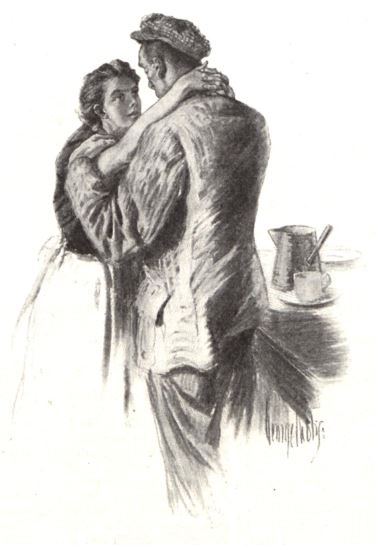
他伸手拿起帽子,向门口走去。他并没有去跟她接吻——他出去时从不跟她接吻道别——可是这天晚上,她却主动地去吻他,用胳膊搂住他,强迫他低下头来跟她亲嘴。他的身体那么魁伟,相形之下,她就显得很小了。
“希望你交上好运,汤姆。”她说,“你一定要打败他。”
“对,我一定要打败他。”他照样说,“反正非这样不可。我一定得打败他。”
他笑了起来,装得很痛快;这时候,她跟他贴得更紧了。他从她的肩膀上瞧了瞧这个空荡荡的房间。这就是他在世界上所有的一切:欠了很久的房租,老婆与孩子。现在,他正在离开家,在黑夜里到外面去为他的老伴和小家伙弄点吃的东西——不过,他并不是像现代的工人一样到车床上去耐心工作,而是用古老的、原始的、威武的、禽兽一样的方式去角斗。
“我一定要打败他。”他重复道,这一次,稍微带着一点拼命的口气。“如果打赢了,那就是三十金镑——我就可以付清全部的账,还剩下一大笔钱。如果打败了,我就什么也得不到——连坐电车回家的一个便士也得不到。秘书已经把输家的那一份全给我了。再会吧,老太婆。要是打赢了,我就马上回来。”
“我等着你。”她在走廊里对他喊道。
到快活俱乐部,足足有两英里路。他一边走,一边想起他当初的黄金时代——他曾经当过新南威尔士的重量级选手——那时候,他常常坐着马车去拳击,而且常有个在他身上押大注的人跟他同路,替他付车钱。就拿汤米·彭斯和那个美国黑人,杰克·约翰逊来说吧——他们都是汽车来往。可是他只好走路!同时,人人都知道,在拳击之前,辛苦地走两英里路不是个最好的办法。他老了,如今的世界对上了年纪的人真是不好。除了做苦工以外,他简直毫无用处。即使这样,他的坏鼻子和肿耳朵还要跟他作对。他真希望当初他学会了一样手艺。从长远来看,那总要好一点。可是从来没有人对他这样说过,再者,他心里也明白,即使有人跟他说过,当时他也不会听的。那时候,生活太轻松了。大笔的进款——激烈、光彩的战斗——中间还有一段段休养和闲游的时间——一大串拼命奉承他的人总是跟在他后面,拍拍他的背,握握他的手,那些阔少也都乐于请他喝酒,借此可以跟他谈五分钟的话,以为莫大的荣幸——那种情形的确光彩:全场观众狂呼起来,他用暴风雨一样的拳法来收场,评判员总是宣布:“汤姆·金胜利!”而第二天体育栏里就会登出他的名字。
那才是黄金时代!但是现在经过他慢慢地回想,他才明白,给他打倒的都是些老头子。那时候,他是青年,正在成长;而他们都是老年人,正在没落。怪不得他赢起来这么容易——原来他们的血管都已肿胀,指节已经打伤,由于长期的拳击比赛,筋骨也已经疲乏。他记起那一次在拉希卡特斯湾,在第十八个回合里他怎样打垮了老斯托什尔·比尔,后来老比尔在更衣室里像小孩子一样哭起来的情形。也许老比尔当时也是拖欠了房租。也许他家里也有一个老婆同两个孩子。也许在拳击的那天,比尔也是渴望吃一块牛排。当时,比尔斗得很勇,因此挨了他无比凶猛的还击。现在,在他自己也受到了这种折磨之后,他才明白在二十年前的那天晚上,斯托什尔·比尔是为了更大的赌注去拳击的,而他,年轻的汤姆·金,不过是为了荣誉和得来容易的钱罢了。难怪斯托什尔·比尔后来要在更衣室里那样痛哭了。
总之,看起来,一个人一生只能斗那么多次。这是拳击比赛的铁的规律。有的人的精力也许能够狠狠地斗一百次,有的人也许只能斗二十次;每一个人根据他的体格和气质,都有一定的数字,等到他斗完了这个数字,他就完了。不错,他斗的次数比大多数同行都多,他所经历的艰苦奋战已经远远超过了他的本分——而这种比赛,总是使心脏同肺仿佛要破裂一样,使动脉失去弹性,使年轻的灵活柔软的肌肉结成硬块,使他神经麻木,精力衰退,而且由于过分用劲与过分忍受使他的头脑同筋骨疲乏不堪。是的,他比他们干得都好。他的老搭档已经一个也没有了。在老一辈的拳师里,他是最后一个。他看见他们一个个完蛋,其中有几个人的完结跟他也有关系。
过去,他们总是拿他来对付那些老家伙,他一个一个地打倒了他们——每逢他们像老斯托什尔·比尔一样,在更衣室里痛哭的时候,他总是觉得可笑。如今,他自己老了,他们又拿那些小伙子来对付他。拿桑德尔这个小家伙来说吧,他是从新西兰来的,运动的成绩留在那儿。可是在澳大利亚,谁也不了解他的情形,所以他们让他跟汤姆·金比赛。如果桑德尔干得出色,他们会让他跟更好的人比赛,赢得更大的奖金。因此,不用说,这一场他一定会斗得非常凶猛。凭着这场比赛,他会赢到一切东西——金钱、荣誉和前途;汤姆·金则是阻碍他走向名利大道的一个头发斑白的老砧板。他什么也赢不到,最多也只有那三十个金镑,让他还清房东和商人的账。就在汤姆·金这样回想的时候,在他的迟钝的头脑里出现了青年的形象——趾高气扬、不可一世的光辉的青年形象,肌肉柔软,皮肤滑润,不知疲倦的健康的心肺,嘲笑力量有限那种论调的青年。是的,青年是涅米塞斯(复仇女神)。他毁掉了老一辈的人,根本不考虑这样做就等于毁掉他自己。这样扩大了他的动脉,击碎了他的指节,结果给下一辈的青年毁掉。因为青年总是年轻的。只有老年才会变老。
走到卡斯尔雷街的时候,他向左转弯,走过三条横马路,就到了快活俱乐部。门外有一群无赖少年,恭恭敬敬地给他让开了一条路,他只听见有一个人对另外一个人说:“那就是他!那就是汤姆·金!”
进去之后,他在去更衣室的路上碰见了俱乐部的秘书,这个年轻人有一双锐利的眼睛,一张机灵的脸。他跟他握了握手。
“你觉得怎么样,汤姆?”他问道。
“好得很。”金回答道,当然,他知道这是撒谎,如果他有一镑钱的话,他会马上买一块上好的牛排。
等到他从更衣室出来,带着他的助手,沿着过道向大厅中央用绳子圈起来的拳击场走去的时候,正在等候演出的观众立刻发出了一片欢迎和喝彩的声音。他向左右的观众还了还礼,可是,没有几张面孔是他认识的。大多数的观众都是他在拳击场里第一次赢得荣誉的时候还没出世的小孩子。他轻快地跳到台上,低下头从绳子下面钻到他那一角,坐在一张折叠凳子上面。评判员杰克·鲍尔过来,跟他握了握手。鲍尔是个垮了台的拳击家,他已经有十多年没有在台上当过主角了。汤姆看到他来当评判员,心里很高兴。他们都是老一辈的人。如果他稍微犯了一点规,对桑德尔稍微过分一点的时候,他知道鲍尔一定会马虎过去的。
年轻的、雄心勃勃的重量级拳击选手一个接着一个地跳到圈子里面,由评判员介绍给观众。同时,他还宣布了他们提出来的挑战。
“年轻的普隆托。”鲍尔宣布道,“是北悉尼人,他愿意另外加五十镑,向赢家挑战。”
观众喝彩之后,等到桑德尔跳到圈子里,坐在他那一角的时候,又喝了一遍彩。汤姆·金好奇地瞧着对面的桑德尔,因为几分钟之后,他们就要在无情的战斗里扭到一块儿,使出全部力量来把对方打昏过去。可是他看不出什么,因为桑德尔跟他一样,也在拳击衣外面套着长裤子和绒线衫。他的脸长得非常英俊,头上一蓬拳曲的黄发,从他那结实的、肌肉发达的脖子,可以看出他的身体一定非常雄壮。
年轻的普隆托从这个角落走到那个角落,跟台上的主角握过手以后,就下去了。挑战继续进行。年轻人不断地跳到圈子里——没有名的,然而不能满足的年轻人——总是向大家喊着,他们要凭自己的力气和本事,向赢家比一比高下。要是几年之前,在他所向无敌的黄金时代,汤姆·金看到这种举动,也许会觉得又好笑,又讨厌。可是现在,他坐在那儿,好像着迷一样,怎么也摆脱不掉他眼睛里的青年的幻象。这些小伙子总是在拳击比赛里占上风,总是从圈子旁跳进来,大声地挑战;而在他们面前倒下来的,总是老一辈的人。他们都是从老一辈的人身上爬到成功之路。他们源源不绝而来,愈来愈多——难以抑止的、不可阻挡的青年——他们总是打倒了老一辈的人,然后自己变得老起来,走着同样的下坡路,而他们后面那些不断涌上来的人,永远是青年——这些新生的婴儿,长得雄壮起来之后,总是再打倒他们的长辈,同时,他们后面又会出现更多新生的婴儿,直到永远——青年一定要实现他们的意志,永远不会死亡。
汤姆向记者席瞧了一眼,跟体育报的摩根和公正报的考尔柏特点了点头。然后他伸出手来,由桑德尔的一个助手严格地检查绕在他指节上的细带,并且在这个人的严密监视之下,由他自己的助手们锡德·沙利文和查利·贝茨给他套上手套,把手套扎紧。同时,在桑德尔那一角,也有汤姆的一个助手,干着同样的事。这时候,桑德尔的裤子已经脱下来了,他一站起来,他的绒线衫也从头上给脱掉了。汤姆·金望过去,看到了青年的具体形象:厚厚的胸脯,强壮的筋肉,一身的肌肉就像活的东西在缎子似的白皮肤下面滚动,全身充满了活跃的生命。汤姆·金知道,这是从来没有失去过朝气的生命,等到在长期的战斗里,这股朝气从发痛的毛孔里泄了出去,青年付出了经过这一关的代价,他就不会再像以前那样年轻了。
这两个人走拢了,锣声一响,那些助手就噼噼啪啪地折起折叠凳子爬到圈子外面去了。他们握过手以后,立刻摆出了拳击的姿势。而桑德尔立刻就像一个由钢铁和弹簧组成的机件,在灵巧的扳机操纵之下,来往不停,一会儿用左拳打汤姆的眼睛,一会儿用右拳打他的肋骨,然后避开对方还来的一拳,轻轻跳开,接着又声势逼人地跳了回来。他的动作很敏捷,很灵巧。这是一种使人眼花缭乱的表演。全场观众都大声喝彩。可是汤姆并没有眼花。他参加过的比赛和遇到的青年对手实在太多了。他知道这种拳法是怎么回事——来势太快太灵活了,不会有危险的。很清楚,桑德尔一开头就想速战速决。这是料想得到的。年轻人总是如此——逞凶撒野,猛攻猛打,肆意消耗自己的光彩和优越性,凭着无限的辉煌的精力和必胜的愿望来压倒对方。
桑德尔一进一退,一会这儿,一会那儿,满场跳来跳去,步伐轻快,心情急切,就像一个由雪白的皮肤和坚实的筋肉构成的活的奇迹。他用身体组成了一个令人眼花缭乱的进攻网,溜过来,跳过去,像飞梭似的一个动作接着一个动作,片刻不停。而这千百个动作针对着一个目的,就是要消灭汤姆·金。因为汤姆·金妨碍他飞黄腾达。可是汤姆·金却耐心地忍受着。他知道该怎么办,他自己虽然不再是青年了,可是他懂得青年。他的想法是,在对方没有丧失一部分精力之前,是没有办法的。于是,他就暗自狞笑了一下,故意地把头一低,挨了重重的一拳。这是个恶毒的办法,不过按照拳赛的规则来说,倒是很正当的。一个人照理是应当保护自己的指节的,因此,如果他一定要打中对手的头顶,那就只能说他是自讨苦吃。金本来可以把头躲得更低一点,让这一拳毫不伤人地落空,可是他想起了在当初的比赛里,他怎样在威尔斯凶神头上打坏了自己的第一个指节的情形。现在,他不过是想取胜。这一低头使桑德尔付出了一个指节的代价。就目前来说,桑德尔是不会在乎的。在这场比赛里,他会毫不介意地继续狠狠地打到底的。不过,以后等到他在拳场上斗得久了,对他开始产生影响的时候,他就会痛惜这个指节,回想起来他怎样在汤姆·金的头上把指节打碎的情形了。
第一个回合完全是桑德尔的天下,他的旋风式的猛攻引起了全场的喝彩声。他的排山倒海的拳法压倒了汤姆,汤姆什么也没有施展。他从来没有回过一拳,他只求掩护、抵挡、躲闪,或者跟对方扭抱起来以免遭到痛击。有时候,他佯攻一下,在拳头落下去的时候摇摇头,然后迟钝地兜来兜去,他从来不跳来跳去,或者浪费一丝精力。一定要等到桑德尔泄掉了青年的锐气,这个谨慎的老年人才敢还手。金的一切动作都是慢腾腾、一板一眼的,他那双眼皮很厚,转动得很慢的眼睛,使他带着一种半睡半醒、茫然若失的神气。可是,这是一双无所不见的眼睛,在二十多年的拳场生活里,他的眼力早就锻炼出来了。即使一拳打到了眼前,它们也不会眨一眨,动一动,却能够冷静地观测出来拳的距离。
在第一个回合结束,休息一分钟的时候,他坐在他那个角落里,伸开两条腿仰面躺着,把胳膊搭在两旁的绳子上;当他吸进去他的助手们用毛巾扇过来的空气时,看得出他的胸膛在深深地起伏着。他闭着眼睛,听到场子里的喊声:“你为什么不斗,汤姆?”很多人都在这样喊:“你并不怕他,是吗?”
“肌肉硬了。”他听见一个坐在前排的人这样议论。“他的动作快不了啦。桑德尔要是输了,我赔双倍,照金镑算。”
锣声一响,两个人都从各自的角落向前走过去。桑德尔急于再战,足足跑到全场四分之三的地方;可是汤姆却情愿少走几步。这完全符合他的节省体力的策略。他既没有锻炼好,又没有吃饱,每一步路都很要紧。再者,他到拳击场已经走了两英里路。这一回合跟第一回合一样,桑德尔仍旧像旋风一样地猛攻,观众都愤愤地质问汤姆·金为什么不打。他假装进攻,不起作用地慢慢挥了几拳,除此之外,他就只采取抵挡、拖延和扭抱的办法。桑德尔要速战速决,可是汤姆很聪明,不肯去迎合桑德尔。他露齿一笑,那张在拳击场上击伤了的脸,露出一种沉思悲愤的神气,继续怀着老年人才有的谨慎,保存着实力。桑德尔是青年,他总是以青年慷慨放纵的气派,浪费他的精力。汤姆是拳击场上的一位将才,他有着由长期的痛苦战斗里得来的智慧。他用冷静的眼光和头脑注视对方,他行动迟缓,等待着桑德尔泄去锐气。在大多数观众看起来,汤姆似乎已经毫无希望地给压倒了,他们表示愿意在桑德尔身上押下三对一的赌注。可是也有几个聪明人,他们知道汤姆过去的情形,因此,他们就接受了他们认为容易赢钱的挑战。
第三个回合开始的时候,仍旧是一面倒,桑德尔仍旧掌握着全部主动权,尽量痛击。半分钟之后,桑德尔由于过分自信,露出了一个破绽。在这刹那间,汤姆眼到手到,他两眼发光,右手像闪电一样打了过去。这是他第一次真正的一击——使了一个勾拳,他把胳膊扭成拱形,使拳头更坚实,同时把旋转一半的身体的全部重量加在拳头上。这就像一头仿佛沉睡的狮子,突然像闪电似的伸出一只爪子来。下巴旁边挨了这一下的桑德尔,立刻像一头阉牛似的倒了下去。观众倒抽了一口气,喃喃地发出了一种敬畏的喝彩声。这个人的肌肉不曾变僵硬,他能够把拳头像大铁锤一样打出去。
桑德尔心惊胆战。他翻了个身,打算爬起来,可是他的助手喝住了他,要他等着计数。他单膝跪着,准备起来,可是仍旧等着。此时裁判监视着他,正在大声对着他的耳朵计数。数到九的时候,他站起来摆出了战斗的姿态;这时候,面对着他的汤姆·金不由得懊悔起来,这一拳要是离桑德尔的下巴尖再近一英寸就好了。那样,他就能把他打昏过去,而他就可以带着三十金镑回家去见自己的老婆孩子了。
这一回合一直打完了规定的三分钟,桑德尔这才初次敬重起他的对手来,可是汤姆的动作仍旧很慢,眼睛仍旧那么昏昏欲睡。汤姆·金看到他的助手们在绳子外面蹲下来,准备跳进来时,就警觉到这个回合快要结束了,于是他就把战斗向他自己的那一角引过去。锣声一响,他立刻坐在那张等着他坐的凳子上,而桑德尔却只好走完这个正方形的对角线,回到他那一角。这是一件小事,不过把很多小事累积起来就是一件大事。桑德尔不得不多走许多路,多消耗许多精力,而且要在这宝贵的一分钟里损失一部分休息时间。在每一回合开始的时候,汤姆·金总是慢腾腾地从他那一角走过去,逼着他的对手要比他走更长的路。而在每一回合结束之前,汤姆总是把战斗引到自己的一角,那么他自己便可以立刻坐下。
在接下来的两个回合里,汤姆·金一直节省着气力,而桑德尔则尽量浪费。桑德尔力求速战速决的攻势弄得他很不舒服。因为那些像雨点似的拳头大部分都打中了。可是汤姆坚持着他的顽固的拖延战略,无论那些急性子的年轻人怎样催他斗,他也不理。后来,在第六个回合里,桑德尔又大意了一次,汤姆的可怕的右拳又像闪电似的打中了他的下巴,于是桑德尔又等到裁判数到九才起来。
打到第七个回合,桑德尔的优势完了,他安定下来,开始应付他知道这是他有生以来最艰苦的一场比赛。汤姆·金是个老家伙,可是比他碰到的那些老家伙要厉害得多——这个老家伙从来不失去理智,他的防守本领非常强,他的拳头就像一根有节的棍子,而且他两只手都能把人打倒。然而,汤姆·金仍旧不敢时常攻打。他从来没有忘记他那些打坏了的指节;他知道,如果要他的指节能够支持到底,他就必须次次打中。当他坐在自己的角落里,瞟着他的对手的时候,他脑中忽然产生一个念头:如果把他的智慧跟桑德尔的青春结合在一起,那就会成为一个闻名世界的重量级锦标选手。可是困难就在这里。桑德尔绝不会变成世界选手。他缺乏智慧,而得到智慧的惟一办法,就是用青春去买;等到他有了智慧,他的青春也就虚度了。
汤姆·金利用一切他所知道的有利的手法。他从来没有放过一次扭抱的机会,每逢扭抱起来,他总是用肩膀硬撞对方的肋骨。按照拳击的理论,就肩膀跟拳头造成的损伤来说是一样的,就消耗体力来说,那简直要好得多。而且,一扭抱起来,汤姆总是把自己的重量压在对方身上,不肯松开。这样就逼得裁判来干涉,把他们拉开,而没有学会休息的桑德尔还帮着裁判来松开。他忍不住,他总是运用他那威风凛凛的飞舞的胳膊和他的扭动不停的肌肉。每逢对方冲过来扭抱,用肩膀抵住他的肋下,而把头靠在他的左臂上的时候,桑德尔几乎总是把右拳从自己背后挥过去,打那个突出的脸。这一手打得很巧妙,观众非常钦佩,然而并不危险,因此,只好算是浪费气力。不过,桑德尔既不知疲倦,也不知节制,而汤姆总是露齿笑着,顽强地忍受着。
后来,桑德尔使出了一种用右拳猛击汤姆的身体的拳法,看起来就像汤姆挨了一顿饱打似的。不过,只有老看拳赛的人才佩服汤姆那种在拳头打到之前的一刹那,用左面的手套碰一碰对方的双头肌的巧妙手法。当然,次次都打中了;可是每一次都因双头肌给碰了一下,便使拳头失去了力量。在第九个回合里,一分钟里一连三次,汤姆都弯着胳膊,用右拳一勾,打中了对方的下巴;一连三次,桑德尔的沉重身体,都给打倒在垫子上。每一次他都在休息了应有的九秒钟之后,才站起来。他虽然摇摇晃晃,有点头昏,不过体力还是很强。他的速度比以前慢多了,可是他浪费的气力也少了。他斗得很苦,可是他会继续利用他的本钱——青春。汤姆的本钱是经验。现在,他的体力衰退了,气力也小了,可是他用策略代替了它们,他会利用他在长期比赛里得来的智慧,他会谨慎地积蓄他的力量。他不仅懂得绝不能有一个多余的动作,他还懂得怎样引诱对方消耗精力。他一再地用手、脚同身体,装作要攻击的样子,引得桑德尔一时向后跳,一时闪避,一时还击。汤姆·金休息着,可是他绝不肯让桑德尔休息。这是老年人的战略。
第十个回合才打起来,汤姆·金就开始用左直拳攻对方的脸,来阻挡对方的猛攻;这时候,桑德尔已经变得谨慎了,他立刻收回左臂,低头一闪,把右拳向上一勾,向汤姆的头旁边打过去。这一拳打得太高,没有真正收效;可是汤姆一挨到拳头,立刻就产生了过去他很熟悉的那种面前一片漆黑、一时昏迷的感觉。一刹那间,或者不如说,在一刹那的万分之一的时间里,他的生命停止了。在这瞬刻之前,他看见桑德尔闪出他的视野,后面背景上的一片注视着的白面孔也不见了;而一瞬间之后,他又看到了桑德尔和背景上的那些面孔。他好像睡了一会儿,才睁开眼睛;不过,不省人事这一刹那间非常短暂,他没有倒下去。观众只看到他摇晃了一下,膝盖一弯,然后又看见他恢复过来,用左肩紧紧地护住下巴。
桑德尔照这样连打了几次,让汤姆一直保持着半昏迷状态,可是汤姆终于想出了一个以攻为守的办法。他假装用左拳进攻,可是马上退后半步,把右拳用全力向上猛攻。他把时间计算得非常准确,趁着桑德尔正在低头闪避时,把拳头端端正正地打到了他的脸上,打得桑德尔两脚腾空,缩成一团向后仰去,脑袋和肩膀同时撞倒在垫子上面。汤姆·金照这样连打中了两次,然后他就放手痛击他的对手,把他逼到绳子上面。他不让桑德尔有一点休息或者振作起来的机会,只顾一拳接一拳地捣下去,直到全场的观众都站起来,空气中充满了狂吼的喝彩声。可是桑德尔的气力和耐力是超群出众的,他仍旧站着。看起来,桑德尔肯定要给击昏过去了。场子旁边的一个警官被这种可怕的狠打吓坏了,连忙站起来阻止这场拳击。等到锣声一响,这一个回合宣告结束的时候,桑德尔一面摇摇晃晃地回到他的角落,一面对警官声明,说他仍旧很好,很有劲。为了证明这一点,他向后连跳了两下,那个警官就退让了。
这时候,靠在自己的角落里喘得很厉害的汤姆·金非常失望。如果这场拳击给阻止了,那么,裁判就会迫不得已作出结论,那三十个金镑就会归他了。他跟桑德尔不一样,他不是为了争荣誉或者前程而来拳击的,他只为了那三十个金镑。现在,桑德尔只要休息一分钟就会恢复过来。
青年总有办法——这句话忽然在汤姆的脑子里一闪,他想起了他头一次听到这句话,是在他打垮斯托什尔·比尔那天晚上。这是那个在拳击之后请他喝酒的家伙,拍着他的肩膀对他说的。青年总有办法!那个家伙说得对。在很久之前的那个晚上,他的确是青年。然而今天晚上,青年却坐在对面的一角。至于他自己呢,他已经斗了半个钟头,他已经是个老头儿了。如果他像桑德尔那样斗,他连十五分钟也支持不了。不过,问题在于:他的气力不能恢复。那些突出的动脉和那颗疲劳已极的心脏使他不能在两个回合之间的休息时间内重振威力。而且,一开头他的气力就不充沛。他的腿很沉重,正在开始抽筋。他不应该在拳击之前走那两英里路。还有他早上一起来就非常想念的那块牛排。他恨透了那个不肯赊账给他的肉店老板。一个没有吃饱的老年人是很难斗胜的。区区一块牛排,最多不过值几个便士,然而对他来说,却等于三十金镑。
第十一个回合的锣声响过之后,桑德尔为了显示他实际上并没有的锐气,发动了猛攻。汤姆知道这是怎么回事——这种虚张声势的把戏跟拳击本身一样古老。为了挽救自己,他扭抱起来,然后松开,让桑德尔摆开阵势。这正是他求之不得的事。他先装做用左拳进攻,引得桑德尔低头一闪,然后他退半步,用右拳向上猛地一钩,迎面击中脸部,打得桑德尔摔倒在垫子上。后来,他一直不让桑德尔休息,尽管他自己也受到痛击,但是他打中的次数要多得多,他打得桑德尔靠在绳子上,上下左右地用各种拳法擂过去,然后挣脱开对方的扭抱,或者用重拳打得对方不能来扭抱。每逢桑德尔快要倒下去的时候,他就用举起的一只手撑住他,而立刻用另一只手打得他靠在绳子上,不摔下去。
这时候,全场都疯狂了,成了汤姆·金的天下,几乎每一个人都在喊:“加油,汤姆!”“打垮他!打垮他!”“你已经胜了,汤姆!你已经胜了!”比赛就要在旋风式的攻击之下结束了,而观众花钱到这儿看的,也正是这个。
半小时以来一直保存着实力的汤姆·金,现在一下子把他所有的力气全使出来了。这是他的惟一的机会——要是现在不赢,就根本赢不了啦。他的气力消耗得很快,他只希望在最后一点气力用完之前,能够打得对方爬不起来。因此,他一面继续猛攻,一面冷静地估计他的拳头的分量和它们造成的损伤,他这才看出桑德尔是一个很难打垮的人。他的体力和耐力简直大到了极点,这是青年的原封未动的体力和耐力。桑德尔一定是个蒸蒸日上的好手。他是一个天生的拳击家。只有这样坚韧的材料,才能创造出成功的斗士。
桑德尔已经摇摇晃晃,站不稳了,可是汤姆的腿也在抽搐,他的指节也痛起来了。不过他还是咬紧牙关,猛捶狠打,每一次都打得自己的手疼得不得了。现在,他虽然实际上一拳也没有挨到,可是他的气力也在跟对方一样迅速地衰弱下去。他次次都打中要害,可是再也没有以前那种分量了,而且每一拳都要经过极大的努力。他的腿跟铅一样重,看得出在拖来拖去;因此,把赌注押在桑德尔身上的人,看到这种情形都很高兴,就大声地鼓励着桑德尔。
这情形刺激得汤姆产生了一股劲儿。他一连打了两拳——左拳打在腹腔神经丛上,稍微高了一点,右拳横击在下巴上。这两拳打得并不重,可是本来就昏迷无力的桑德尔已经倒下去,躺在垫子上直哆嗦。裁判监视着他,对着他的耳朵,大声数着有关生死的秒数。如果在数到十秒之前他还没有起来,他就输了。全场的观众都肃静无声地站着。汤姆·金两腿发抖,勉强支持着。他感到一阵剧烈的眩晕,观众的脸好像一片大海,在他眼前波澜起伏,裁判数数的声音好像是从很远的地方传到他耳朵里的。可是他认为自己是赢定了。一个挨了这么多重拳的人是不可能站起来的。
只有青年人能够站起来,桑德尔终于站起来了。数到四的时候,他翻了个身,面孔朝下,盲目地摸索那些绳子。数到七的时候,他把身子拖了起来,用一条腿跪着,一面休息,一面像喝醉了似的摇晃着脑袋。等到裁判喊了一声“九!”的时候,桑德尔已经笔直地站了起来,摆出适当的招架姿势,用左臂护着脸,右臂护着胃部。他护住要害以后,就摇摇摆摆地向汤姆走过去,希望能跟对方扭抱在一块儿,以便争取时间。
桑德尔一起来,汤姆·金就开始进攻,不料打出去的两拳都给招架的胳膊挡住了,接着,桑德尔就跟他扭在一起,拼命地抵住他,裁判费了很大力气才把他们拉开。汤姆也帮着摆脱自己。他知道青年人恢复得很快,而且知道,只要他能不让桑德尔恢复,桑德尔就会败在他手下。只要狠狠的一拳就够了。桑德尔已经败在他的手下,这已经是无疑的了。他已经在战略和战术上胜过他,占了上风。汤姆·金从扭抱中摆脱出来,摇摇晃晃,他的成败得失就在毫发之间。只要好好的一拳,就能把他打倒,叫他完蛋。汤姆·金忽然一阵悲痛,想到了那块牛排若来支撑他这必要的一击,那有多好啊!他鼓足力气,打了一拳,可是分量不够重,出手也不够快。桑德尔摇摆了一下,没有摔倒,蹒跚地退到绳子旁边就支撑住了。汤姆·金蹒跚地追过去,忍受着揪心的剧疼,又打了一拳。可是他的身体已经不听指挥了。他只剩下了一种要斗下去的意识,然而由于疲劳过度,连这一点意识也很模糊。这一拳他是对着下巴打过去的,可是只打到肩膀上。他本来想打得高一点的,可是疲劳的肌肉不服从指挥。同时,他自己却受了这一拳回冲力的影响,踉跄地倒退回来,几乎栽倒。后来他又勉强打出了一拳。这一次简直完全落空,他因为身体衰弱到了极点,就倒在桑德尔身上,跟他扭抱在一块儿,以免自己摔倒。
汤姆一点不想挣脱开来。他的力气已经用光了。他垮了。青年总有办法。即使在扭抱的时候,他也觉得桑德尔的体力变得比他强起来。等到裁判把他们拉开的时候,他所看到的已经是一个身体复原的青年。桑德尔变得一刻比一刻强壮。他的拳头起初还是软绵绵的,不起作用。现在已经变得又硬又准了。汤姆的昏花眼睛看见他的戴手套的拳头正在向自己的下巴打来,他打算抬起胳膊来保护。他看到了这个危险,而且准备这样做,可是他的胳膊太重了。它好像一百多磅的铅块那么重。它不能自动地举起来,因此他就拼命集中意志要抬起这只胳膊。这时候,那只戴手套的拳头已经打中他了。他好像给电火击中一样,感到了一种剧烈的痛苦,同时,眼前一黑,他就什么都不知道了。
等到他再睁开眼睛的时候,他已经坐在自己的一角,只听见观众的喊声像邦狄海滨的惊涛骇浪一样。他的后脑压在一块潮湿的海绵上,锡德·沙利文正在向他脸上和胸口上喷冷水,让他苏醒过来。他的手套已经给脱下了,桑德尔正弯下腰来,跟他握手。他一点也不恨这个打昏了他的人,因此,他热诚地跟他握手,一直握得自己的破指节疼得受不了。然后,桑德尔就走到拳击场当中,观众停止了喧嚣,听他讲话。他接受了年轻的普隆托的挑战,而且建议把超过一般赌注的赌注增加到一百镑。汤姆无动于衷地听着,这时他的助手们拭去他身上的热汗,揩干他的脸,以便他可以出场。他觉得很饿。这不是那种寻常的、胃很疼的饥饿感觉,而是一种极度的衰弱,一种心口悸动,传遍全身的感觉。他回想起刚才比赛时桑德尔摇摇欲坠、快要失败的那一刻。唉,一块牛排就顶用了!决定胜负的那一拳就缺少这块牛排,现在他输了。这全因为那块牛排。
他的助手们扶着他,帮助他钻过绳子。他挣脱他们的手,自个儿低头钻过绳子,沉重地跳到地板上,跟在替他从拥塞的中央过道挤出一条路的助手们后面。当他离开更衣室到街上去的时候,有一个年轻人在大厅的入口对他说了几句话。
“刚才他在你手掌之中的时候,你为什么不把他打倒呢?”这个小伙子问道。
“去你妈的!”汤姆·金一面说,一面走下台阶,到了人行道上。
街角上酒店的门开得大大的,他看到那些灯光和含笑的女侍者,听到很多人都在谈论这次比赛,他还听到了柜台上生意兴隆的丁当直响的钱币声。有人喊他喝一杯。看得出来他犹豫了一下,就谢绝了,继续走路。
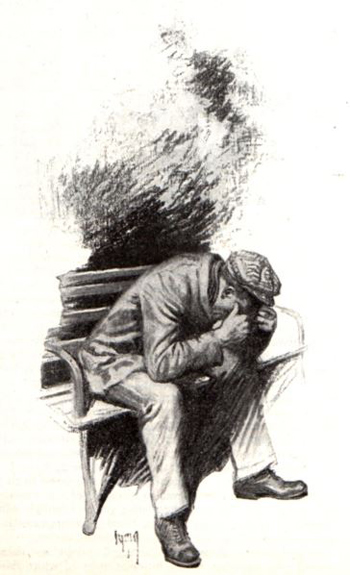
他口袋里连一个铜板也没有,回家的两英里路好像特别长。他的确老了。走过陶门公园的时候,他突然在一张凳子上垂头丧气地坐下来,因为他想起了他的老婆正坐着等他,等着听赛拳的结果。这比任何致命的拳头都沉重,简直无法承受。
他觉得人很虚弱,身上处处酸疼。那些打碎了的指节也很疼,它们在警告他,即使他找到了一种粗活儿,也要等一个星期他才能握得住一把锄头或者铲子。饿得心口悸动的感觉使他想要呕吐。悲惨的心情压倒了他,他眼睛里涌出了不常有的泪水,他用手蒙住脸,一面哭,一面想起了很久之前那天晚上他对待斯托什尔·比尔的情形。可怜的老斯托什尔·比尔!现在他才明白了比尔为什么在更衣室里痛哭。
A Piece of Steak
Jack London, 1909
With the last morsel of bread Tom King wiped his plate clean of the last particle of flour gravy and chewed the resulting mouthful in a slow and meditative way. When he arose from the table he was oppressed by the feeling that he was distinctly hungry. Yet he alone had eaten. The two children in the other room had been sent early to bed in order that in sleep they might forget they had gone supperless. His wife had touched nothing, and had sat silently and watched him with solicitous eyes. She was a thin, worn woman of the working class, though signs of an earlier prettiness were not wanting in her face. The flour for the gravy she had borrowed from the neighbor across the hall. The last two ha’pennies had gone to buy the bread.
He sat down by the window on a rickety chair that protested under his weight, and quite mechanically he put his pipe in his mouth and dipped into the side pocket of his coat. The absence of any tobacco made him aware of his action and, with a scowl for his forgetfulness, he put the pipe away. His movements were slow, almost hulking, as though he were burdened by the heavy weight of his muscles. He was a solid-bodied, stolid-looking man, and his appearance did not suffer from being overprepossessing. His rough clothes were old and slouchy. The uppers of his shoes were too weak to carry the heavy resoling that was itself of no recent date. And his cotton shirt, a cheap, two-shilling affair, showed a frayed collar and ineradicable paint stains.
But it was Tom King’s face that advertised him unmistakably for what he was. It was the face of a typical prizefighter; of one who had put in long years of service in the squared ring and, by that means, developed and emphasized all the marks of the fighting beast. It was distinctly a lowering countenance, and, that no feature of it might escape notice, it was clean-shaven. The lips were shapeless and constituted a mouth harsh to excess, that was like a gash in his face. The jaw was aggressive, brutal, heavy. The eyes, slow of movement and heavy-lidded, were almost expressionless under the shaggy, indrawn brows. Sheer animal that he was, the eyes were the most animal-like feature about him. They were sleepy, lionlike — the eyes of a fighting animal. The forehead slanted quickly back to the hair, which, clipped close, showed every bump of the villainous-looking head. A nose, twice broken and moulded variously by countless blows, and a cauliflower ear, permanently swollen and distorted to twice its size, completed his adornment, while the beard, fresh-shaven as it was, sprouted in the skin and gave the face a blue-black stain.
Altogether, it was the face of a man to be afraid of in a dark alley or lonely place. And yet Tom King was not a criminal, nor had he ever done anything criminal. Outside of brawls, common to his walk in life, he had harmed no one. Nor had he ever been known to pick a quarrel. He was a professional, and all the fighting brutishness of him was reserved for his professional appearances. Outside the ring he was slow-going, easy-natured, and, in his younger days when money was flush, too open-handed for his own good. He bore no grudges and had few enemies. Fighting was a business with him. In the ring he struck to hurt, struck to maim, struck to destroy; but there was no animus in it. It was a plain business proposition. Audiences assembled and paid for the spectacle of men knocking each other out. The winner took the big end of the purse. When Tom King faced the Woolloomoolloo Gouger, twenty years before, he knew that the Gouger’s jaw was only four months healed after having been broken in a Newcastle bout. And he had played for that jaw and broken it again in the ninth round, not because he bore the Gouger any ill will, but because that was the surest way to put the Gouger out and win the big end of the purse. Nor had the Gouger borne him any ill will for it. It was the game, and both knew the game and played it.
Tom King had never been a talker, and he sat by the window, morosely silent, staring at his hands. The veins stood out on the backs of the hands, large and swollen; and the knuckles, smashed and battered and malformed, testified to the use to which they had been put. He had never heard that a man’s life was the life of his arteries, but well he knew the meaning of those big, upstanding veins. His heart had pumped too much blood through them at top pressure. They no longer did the work. He had stretched the elasticity out of them, and with their distention had passed his endurance. He tired easily now. No longer could he do a fast twenty rounds, hammer and tongs, fight, fight, fight, from gong to gong, with fierce rally on top of fierce rally, beaten to the ropes and in turn beating his opponent to the ropes, and rallying fiercest and fastest of all in that last, twentieth round, with the house on its feet and yelling, himself rushing, striking, ducking, raining showers of blows upon showers of blows and receiving showers of blows in return, and all the time the heart faithfully pumping the surging blood through the adequate veins. The veins, swollen at the time, had always shrunk down again, though not quite — each time, imperceptibly at first, remaining just a trifle larger than before. He stared at them and at his battered knuckles, and, for the moment, caught a vision of the youthful excellence of those hands before the first knuckle had been smashed on the head of Benny Jones, otherwise known as the Welsh Terror.
The impression of his hunger came back on him.
“Blimey, but couldn’t I go a piece of steak!” he muttered aloud, clenching his huge fists and spitting out a smothered oath.
“I tried both Burke’s an’ Sawley’s,” his wife said half apologetically.
“An’ they wouldn’t?” he demanded.
“Not a ha’penny. Burke said — ” She faltered.
“G’wan! Wot ‘d he say?”
“As how ‘e was thinkin’ Sandel ud do ye tonight, an’ as how yer score was comfortable big as it was.”
Tom King grunted, but did not reply. He was busy thinking of the bull terrier he had kept in his younger days to which he had fed steaks without end. Burke would have given him credit for a thousand steaks — then. But times had changed. Tom King was getting old; and old men, fighting before second-rate clubs, couldn’t expect to run bills of any size with the tradesmen.
He had got up in the morning with a longing for a piece of steak, and the longing had not abated. He had not had a fair training for this fight. It was a drought year in Australia, times were hard and even the most irregular work was difficult to find. He had had no sparring partner and his food had not been of the best nor always sufficient. He had done a few days’ navvy work when he could get it, and he had run around the Domain in the early mornings to get his legs in shape. But it was hard training without a partner and with a wife and two kiddies that must be fed. Credit with the tradesmen had undergone very slight expansion when he was matched with Sandel. The secretary of the Gayety Club had advanced him three pounds — the loser’s end of the purse — and beyond that had refused to go. Now and again he had managed to borrow a few shillings from old pals, who would have lent more only that it was a drought year and they were hard put themselves. No — and there was no use in disguising the fact — his training had not been satisfactory. He should have had better food and no worries. Besides, when a man is forty it is harder to get into condition than when he is twenty.
“What time is it, Lizzie?” he asked.
His wife went across the hall to inquire and came back. “Quarter before eight.”
“They’ll be startin’ the first bout in a few minutes,” he said. “Only a tryout. Then there’s a four-round spar ‘tween Dealer Wells an’ Gridley, an’ a ten-round go ‘tween Starlight an’ some sailor bloke. I don’t come on for over an hour.”
At the end of another silent ten minutes he rose to his feet.
“Truth is, Lizzie, I ain’t had proper trainin’.”
He reached for his hat and started for the door. He did not offer to kiss her — he never did on going out — but on this night she dared to kiss him, throwing her arms around him and compelling him to bend down to her face. She looked quite small against the massive bulk of the man.
“Good luck, Tom,” she said. “You gotter do ‘im.”
“Ay, I gotter do ‘im,” he repeated. “That’s all there is to it. I jus’ gotter do ‘im.”
He laughed with an attempt at heartiness, while she pressed more closely against him. Across her shoulders he looked around the bare room. It was all he had in the world, with the rent overdue, and her and the kiddies. And he was leaving it to go out into the night to get meat for his mate and cubs — not like a modern workingman going to his machine grind, but in the old, primitive, royal, animal way, by fighting for it.
“I gotter do ‘im,” he repeated, this time a hint of desperation in his voice. “If it’s a win it’s thirty quid — an’ I can pay all that’s owin’, with a lump o’ money left over. If it’s a lose I get naught — not even a penny for me to ride home on the tram. The secretary’s give all that’s comin’ from a loser’s end. Goodbye, old woman. I’ll come straight home if it’s a win.”
“An’ I’ll be waitin’ up,” she called to him along the hall. It was a full two miles to the Gayety, and as he walked along he remembered how in his palmy days — he had once been the heavyweight champion of New South Wales — he would have ridden in a cab to the fight, and how, most likely, some heavy backer would have paid for the cab and ridden with him. There were Tommy Burns and that Yankee nigger, Jack Johnson — they rode about in motor cars. And he walked! And, as any man knew, a hard two miles was not the best preliminary to a fight. He was an old un, and the world did not wag well with old uns. He was good for nothing now except navvy work, and his broken nose and swollen ear were against him even in that. He found himself wishing that he had learned a trade. It would have been better in the long run. But no one had told him, and he knew, deep down in his heart, that he would not have listened if they had. It had been so easy. Big money — sharp, glorious fights — periods of rest and loafing in between — a following of eager flatterers, the slaps on the back, the shakes of the hand, the toffs glad to buy him a drink for the privilege of five minutes’ talk — and the glory of it, the yelling houses, the whirlwind finish, the referee’s “King wins!” and his name in the sporting columns next day.
Those had been times! But he realized now, in his slow, ruminating way, that it was the old uns he had been putting away. He was Youth, rising; and they were Age, sinking. No wonder it had been easy — they with their swollen veins and battered knuckles and weary in the bones of them from the long battles they had already fought. He remembered the time he put out old Stowsher Bill, at Rush-Cutters Bay, in the eighteenth round, and how old Bill had cried afterward in the dressing-room like a baby. Perhaps old Bill’s rent had been overdue. Perhaps he’d had at home a missus an’ a couple of kiddies. And perhaps Bill, that very day of the fight, had had a hungering for a piece of steak. Bill had fought game and taken incredible punishment. He could see now, after he had gone through the mill himself, that Stowsher Bill had fought for a bigger stake, that night twenty years ago, than had young Tom King, who had fought for glory and easy money. No wonder Stowsher Bill had cried afterward in the dressing room.
Well, a man had only so many fights in him, to begin with. It was the iron law of the game. One man might have a hundred hard fights in him, another man only twenty; each, according to the make of him and the quality of his fiber, had a definite number, and when he had fought them he was done. Yes, he had had more fights in him than most of them, and he had had far more than his share of the hard, grueling fights — the kind that worked the heart and lungs to bursting, that took the elastic out of the arteries and made hard knots of muscle out of youth’s sleek suppleness, that wore out nerve and stamina and made brain and bones weary from excess of effort and endurance overwrought. Yes, he had done better than all of them. There was none of his old fighting partners left. He was the last of the old guard. He had seen them all finished, and he had had a hand in finishing some of them.
They had tried him out against the old uns, and one after another he had put them away — laughing when, like old Stowsher Bill, they cried in the dressing room. And now he was an old un, and they tried out the youngsters on him. There was that bloke, Sandel. He had come over from New Zealand with a record behind him. But nobody in Australia knew anything about him, so they put him up against old Tom King. If Sandel made a showing he would be given better men to fight, with bigger purses to win; so it was to be depended upon that he would put up a fierce battle. He had everything to win by it — money and glory and career; and Tom King was the grizzled old chopping-block that guarded the highway to fame and fortune. And he had nothing to win except thirty quid, to pay to the landlord and the tradesmen. And, as Tom King thus ruminated, there came to his stolid vision the form of Youth, glorious Youth, rising exultant and invincible, supple of muscle and silken of skin, with heart and lungs that had never been tired and torn and that laughed at limitation of effort. Yes, Youth was the Nemesis. It destroyed the old uns and reeked not that, in so doing, it destroyed itself. It enlarged its arteries and smashed its knuckles, and was in turn destroyed by Youth. For Youth was ever youthful. It was only Age that grew older.
At Castlereagh Street he turned to the left, and three blocks along came to the Gayety. A crowd of young larrikins hanging outside the door made respectful way for him, and he heard one say to another: “That’s ‘im! That’s Tom King!”
Inside, on the way to his dressing room, he encountered the secretary, a keen-eyed, shrewd-faced young man who shook his hand.
“How are you feelin’, Tom?” he asked.
“Fit as a fiddle,” King answered, though he knew that he lied, and that if he had a quid he would give it right there for a good piece of steak.
When he emerged from the dressing room, his seconds behind him, and came down the aisle to the squared ring in the center of the hall, a burst of greeting and applause went up from the waiting crowd. He acknowledged salutations right and left, though few of the faces did he know. Most of them were the faces of kiddies unborn when he was winning his first laurels in the squared ring. He leaped lightly to the raised platform and ducked through the ropes to his corner, where he sat down on a folding stool. Jack Ball, the referee, came over and shook his hand. Ball was a broken-down pugilist who for over ten years had not entered the ring as a principal. King was glad that he had him for referee. They were both old uns. If he should rough it with Sandel a bit beyond the rules he knew Ball could be depended upon to pass it by.
Aspiring young heavyweights, one after another, were climbing into the ring and being presented to the audience by the referee. Also, he issued their challenges for them.
“Young Pronto,” Ball announced, “from North Sydney, challenges the winner for fifty pounds side bet.”
The audience applauded, and applauded again as Sandel himself sprang through the ropes and sat down in his corner. Tom King looked across the ring at him curiously, for in a few minutes they would be locked together in merciless combat, each trying with all the force of him to knock the other into unconsciousness. But little could he see, for Sandel, like himself, had trousers and sweater on over his ring costume. His face was strongly handsome, crowned with a curly mop of yellow hair, while his thick, muscular neck hinted at bodily magnificence.
Young Pronto went to one corner and then the other, shaking hands with the principals and dropping down out of the ring. The challenges went on. Ever Youth climbed through the ropes — Youth unknown, but insatiable — crying out to mankind that with strength and skill it would match issues with the winner. A few years before, in his own heyday of invincibleness, Tom King would have been amused and bored by these preliminaries. But now he sat fascinated, unable to shake the vision of Youth from his eyes. Always were these youngsters rising up in the boxing game, springing through the ropes and shouting their defiance; and always were the old uns going down before them. They climbed to success over the bodies of the old uns. And ever they came, more and more youngsters — Youth unquenchable and irresistible — and ever they put the old uns away, themselves becoming old uns and traveling the same downward path, while behind them, ever pressing on them, was Youth eternal — the new babies, grown lusty and dragging their elders down, with behind them more babies to the end of time — Youth that must have its will and that will never die.
King glanced over to the press box and nodded to Morgan, of the Sportsman, and Corbett, of the Referee. Then he held out his hands, while Sid Sullivan and Charley Bates, his seconds, slipped on his gloves and laced them tight, closely watched by one of Sandel’s seconds, who first examined critically the tapes on King’s knuckles. A second of his own was in Sandel’s corner, performing a like office. Sandel’s trousers were pulled off and, as he stood up, his sweater was skinned off over his head. And Tom King, looking, saw Youth incarnate, deepchested, heavy-thewed, with muscles that slipped and slid like live things under the white satin skin. The whole body was acrawl with life, and Tom King knew that it was a life that had never oozed its freshness out through the aching pores during the long fights wherein Youth paid its toll and departed not quite so young as when it entered.
The two men advanced to meet each other and, as the gong sounded and the seconds clattered out of the ring with the folding stools, they shook hands with each other and instantly took their fighting attitudes. And instantly, like a mechanism of steel and springs balanced on a hair trigger, Sandel was in and out and in again, landing a left to the eyes, a right to the ribs, ducking a counter, dancing lightly away and dancing menacingly back again. He was swift and clever. It was a dazzling exhibition. The house yelled its approbation. But King was not dazzled. He had fought too many fights and too many youngsters. He knew the blows for what they were — too quick and too deft to be dangerous. Evidently Sandel was going to rush things from the start. It was to be expected. It was the way of Youth, expending its splendor and excellence in wild insurgence and furious onslaught, overwhelming opposition with its own unlimited glory of strength and desire.
Sandel was in and out, here, there and everywhere, light-footed and eager-hearted, a living wonder of white flesh and stinging muscle that wove itself into a dazzling fabric of attack, slipping and leaping like a flying shuttle from action to action through a thousand actions, all of them centered upon the destruction of Tom King, who stood between him and fortune. And Tom King patiently endured. He knew his business, and he knew Youth now that Youth was no longer his. There was nothing to do till the other lost some of his steam, was his thought, and he grinned to himself as he deliberately ducked so as to receive a heavy blow on the top of his head. It was a wicked thing to do, yet eminently fair according to the rules of the boxing game. A man was supposed to take care of his own knuckles, and if he insisted on hitting an opponent on the top of the head he did so at his own peril. King could have ducked lower and let the blow whiz harmlessly past, but he remembered his own early fights and how he smashed his first knuckle on the head of the Welsh Terror. He was but playing the game. That duck had accounted for one of Sandel’s knuckles. Not that Sandel would mind it now. He would go on, superbly regardless, hitting as hard as ever throughout the fight. But later on, when the long ring battles had begun to tell, he would regret that knuckle and look back and remember how he smashed it on Tom King’s head.
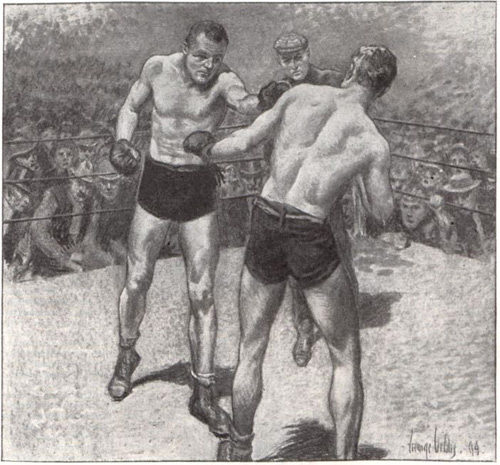
The first round was all Sandel’s, and he had the house yelling with the rapidity of his whirlwind rushes. He overwhelmed King with avalanches of punches, and King did nothing. He never struck once, contenting himself with covering up, blocking and ducking and clinching to avoid punishment. He occasionally feinted, shook his head when the weight of a punch landed, and moved stolidly about, never leaping or springing or wasting an ounce of strength. Sandel must foam the froth of Youth away before discreet Age could dare to retaliate. All King’s movements were slow and methodical, and his heavy-lidded, slow-moving eyes gave him the appearance of being half asleep or dazed. Yet they were eyes that saw everything, that had been trained to see everything through all his twenty years and odd in the ring. They were eyes that did not blink or waver before an impending blow, but that coolly saw and measured distance.
Seated in his corner for the minute’s rest at the end of the round, he lay back with outstretched legs, his arms resting on the right angle of the ropes, his chest and abdomen heaving frankly and deeply as he gulped down the air driven by the towels of his seconds. He listened with closed eyes to the voices of the house. “Why don’t yeh fight, Tom?” many were crying. “Yeh ain’t afraid of ‘im, are yeh?”
“Muscle-bound,” he heard a man on a front seat comment. “He can’t move quicker. Two to one on Sandel, in quids.”
The gong struck and the two men advanced from their corners. Sandel came forward fully three-quarters of the distance, eager to begin again; but King was content to advance the shorter distance. It was in line with his policy of economy. He had not been well-trained and he had not had enough to eat, and every step counted. Besides, he had already walked two miles to the ringside. It was a repetition of the first round, with Sandel attacking like a whirlwind and with the audience indignantly demanding why King did not fight. Beyond feinting and several slowly-delivered and ineffectual blows he did nothing save block and stall and clinch. Sandel wanted to make the pace fast, while King, out of his wisdom, refused to accommodate him. He grinned with a certain wistful pathos in his ring-battered countenance, and went on cherishing his strength with the jealousy of which only Age is capable. Sandel was Youth, and he threw his strength away with the munificent abandon of Youth. To King belonged the ring generalship, the wisdom bred of long, aching fights. He watched with cool eyes and head, moving slowly and waiting for Sandel’s froth to foam away. To the majority of the onlookers it seemed as though King was hopelessly outclassed, and they voiced their opinion in offers of three to one on Sandel. But there were wise ones, a few, who knew King of old time and who covered what they considered easy money.
The third round began as usual, one-sided, with Sandel doing all the leading and delivering all the punishment. A half-minute had passed when Sandel, overconfident, left an opening. King’s eyes and right arm flashed in the same instant. It was his first real blow — a hook, with the twisted arch of the arm to make it rigid, and with all the weight of the half-pivoted body behind it. It was like a sleepy-seeming lion suddenly thrusting out a lightning paw. Sandel, caught on the side of the jaw, was felled like a bullock. The audience gasped and murmured awestricken applause. The man was not muscle-bound, after all, and he could drive a blow like a trip hammer.
Sandel was shaken. He rolled over and attempted to rise, but the sharp yells from his seconds to take the count restrained him. He knelt on one knee, ready to rise, and waited, while the referee stood over him, counting the seconds loudly in his ear. At the ninth he rose in fighting attitude, and Tom King, facing him, knew regret that the blow had not been an inch nearer the point of the jaw. That would have been a knockout, and he could have carried the thirty quid home to the missus and the kiddies.
The round continued to the end of its three minutes, Sandel for the first time respectful of his opponent and King slow of movement and sleepy-eyed as ever. As the round neared its close King, warned of the fact by sight of the seconds crouching outside ready for the spring in through the ropes, worked the fight around to his own corner. And when the gong struck he sat down immediately on the waiting stool, while Sandel had to walk all the way across the diagonal of the square to his own corner. It was a little thing, but it was the sum of little things that counted. Sandel was compelled to walk that many more steps, to give up that much energy and to lose a part of the precious minute of rest. At the beginning of every round King loafed slowly out from his corner, forcing his opponent to advance the greater distance. The end of every round found the fight maneuvered by King into his own corner so that he could immediately sit down.
Two more rounds went by, in which King was parsimonious of effort and Sandel prodigal. The latter’s attempt to force a fast pace made King uncomfortable, for a fair percentage of the multitudinous blows showered upon him went home. Yet King persisted in his dogged slowness, despite the crying of the young hotheads for him to go in and fight. Again, in the sixth round, Sandel was careless, again Tom King’s fearful right flashed out to the jaw, and again Sandel took the nine seconds’ count.
By the seventh round Sandel’s pink of condition was gone and he settled down to what he knew was to be the hardest fight in his experience. Tom King was an old un, but a better old un than he had ever encountered — an old un who never lost his head, who was remarkably able at defense, whose blows had the impact of a knotted club and who had a knockout in either hand. Nevertheless, Tom King dared not hit often. He never forgot his battered knuckles, and knew that every hit must count if the knuckles were to last out the fight. As he sat in his corner, glancing across at his opponent, the thought came to him that the sum of his wisdom and Sandel’s youth would constitute a world’s champion heavyweight. But that was the trouble. Sandel would never become a world champion. He lacked the wisdom, and the only way for him to get it was to buy it with Youth; and when wisdom was his, Youth would have been spent in buying it.
King took every advantage he knew. He never missed an opportunity to clinch, and in effecting most of the clinches his shoulder drove stiffly into the other’s ribs. In the philosophy of the ring a shoulder was as good as a punch so far as damage was concerned, and a great deal better so far as concerned expenditure of effort. Also, in the clinches King rested his weight on his opponent and was loth to let go. This compelled the interference of the referee, who tore them apart, always assisted by Sandel, who had not yet learned to rest. He could not refrain from using those glorious flying arms and writhing muscles of his, and when the other rushed into a clinch, striking shoulder against ribs and with head resting under Sandel’s left arm, Sandel almost invariably swung his right behind his own back and into the projecting face. It was a clever stroke, much admired by the audience, but it was not dangerous, and was, therefore, just that much wasted strength. But Sandel was tireless and unaware of limitations, and King grinned and doggedly endured.
Sandel developed a fierce right to the body, which made it appear that King was taking an enormous amount of punishment, and it was only the old ringsters who appreciated the deft touch of King’s left glove to the other’s biceps just before the impact of the blow. It was true, the blow landed each time; but each time it was robbed of its power by that touch on the biceps. In the ninth round, three times inside a minute, King’s right hooked its twisted arch to the jaw; and three times Sandel’s body, heavy as it was, was leveled to the mat. Each time he took the nine seconds allowed him and rose to his feet, shaken and jarred, but still strong. He had lost much of his speed and he wasted less effort. He was fighting grimly; but he continued to draw upon his chief asset, which was Youth. King’s chief asset was experience. As his vitality had dimmed and his vigor abated he had replaced them with cunning, with wisdom born of the long fights and with a careful shepherding of strength. Not alone had he learned never to make a superfluous movement, but he had learned how to seduce an opponent into throwing his strength away. Again and again, by feint of foot and hand and body he continued to inveigle Sandel into leaping back, ducking or countering. King rested, but he never permitted Sandel to rest. It was the strategy of Age.
Early in the tenth round King began stopping the other’s rushes with straight lefts to the face, and Sandel, grown wary, responded by drawing the left; then by ducking it and delivering his right in a swinging hook to the side of the head. It was too high up to be vitally effective; but when first it landed King knew the old, familiar descent of the black veil of unconsciousness across his mind. For the instant, or for the slightest fraction of an instant rather, he ceased. In the one moment he saw his opponent ducking out of his field of vision and the background of white, watching faces; in the next moment he again saw his opponent and the background of faces. It was as if he had slept for a time and just opened his eyes again, and yet the interval of unconsciousness was so microscopically short that there had been no time for him to fall. The audience saw him totter and his knees give, and then saw him recover and tuck his chin deeper into the shelter of his left shoulder.
Several times Sandel repeated the blow, keeping King partially dazed, and then the latter worked out his defense, which was also a counter. Feinting with his left he took a half-step backward, at the same time uppercutting with the whole strength of his right. So accurately was it timed that it landed squarely on Sandel’s face in the full, downward sweep of the duck, and Sandel lifted in the air and curled backward, striking the mat on his head and shoulders. Twice King achieved this, then turned loose and hammered his opponent to the ropes. He gave Sandel no chance to rest or to set himself, but smashed blow in upon blow till the house rose to its feet and the air was filled with an unbroken roar of applause. But Sandel’s strength and endurance were superb, and he continued to stay on his feet. A knockout seemed certain, and a captain of police, appalled at the dreadful punishment, arose by the ringside to stop the fight. The gong struck for the end of the round and Sandel staggered to his corner, protesting to the captain that he was sound and strong. To prove it he threw two back air springs, and the police captain gave in.
Tom King, leaning back in his corner and breathing hard, was disappointed. If the fight had been stopped the referee, perforce, would have rendered him the decision and the purse would have been his. Unlike Sandel, he was not fighting for glory or career, but for thirty quid. And now Sandel would recuperate in the minute of rest.
Youth will be served — this saying flashed into King’s mind, and he remembered the first time he had heard it, the night when he had put away Stowsher Bill. The toff who had bought him a drink after the fight and patted him on the shoulder had used those words. Youth will be served! The toff was right. And on that night in the long ago he had been Youth. Tonight Youth sat in the opposite corner. As for himself, he had been fighting for half an hour now, and he was an old man. Had he fought like Sandel he would not have lasted fifteen minutes. But the point was that he did not recuperate. Those upstanding arteries and that sorely-tried heart would not enable him to gather strength in the intervals between the rounds. And he had not had sufficient strength in him to begin with. His legs were heavy under him and beginning to cramp. He should not have walked those two miles to the fight. And there was the steak which he had got up longing for that morning. A great and terrible hatred rose up in him for the butchers who had refused him credit. It was hard for an old man to go into a fight without enough to eat. And a piece of steak was such a little thing, a few pennies at best; yet it meant thirty quid to him.
With the gong that opened the eleventh round Sandel rushed, making a show of freshness which he did not really possess. King knew it for what it was — a bluff as old as the game itself. He clinched to save himself, then, going free, allowed Sandel to get set. This was what King desired. He feinted with his left, drew the answering duck and swinging upward hook, then made the half-step backward, delivered the uppercut full to the face and crumpled Sandel over to the mat. After that he never let him rest, receiving punishment himself, but inflicting far more, smashing Sandel to the ropes, hooking and driving all manner of blows into him, tearing away from his clinches or punching him out of attempted clinches, and ever, when Sandel would have fallen, catching him with one uplifting hand and with the other immediately smashing him into the ropes where he could not fall.
The house by this time had gone mad, and it was his house, nearly every voice yelling: “Go it, Tom!” “Get ‘im! Get ‘im!” “You’ve got ‘im, Tom! You’ve got ‘im!” It was to be a whirlwind finish, and that was what a ringside audience paid to see.
And Tom King, who for half an hour had conserved his strength, now expended it prodigally in the one great effort he knew he had in him. It was his one chance — now or not at all. His strength was waning fast, and his hope was that before the last of it ebbed out of him he would have beaten his opponent down for the count. And as he continued to strike and force, coolly estimating the weight of his blows and the quality of the damage wrought, he realized how hard a man Sandel was to knock out. Stamina and endurance were his to an extreme degree, and they were the virgin stamina and endurance of Youth. Sandel was certainly a coming man. He had it in him. Only out of such rugged fiber were successful fighters fashioned.
Sandel was reeling and staggering, but Tom King’s legs were cramping and his knuckles going back on him. Yet he steeled himself to strike the fierce blows, every one of which brought anguish to his tortured hands. Though now he was receiving practically no punishment he was weakening as rapidly as the other. His blows went home, but there was no longer the weight behind them, and each blow was the result of a severe effort of will. His legs were like lead, and they dragged visibly under him; while Sandel’s backers, cheered by this symptom, began calling encouragement to their man.
King was spurred to a burst of effort. He delivered two blows in succession — a left, a trifle too high, to the solar plexus, and a right cross to the jaw. They were not heavy blows, yet so weak and dazed was Sandel that he went down and lay quivering. The referee stood over him, shouting the count of the fatal seconds in his ear. If before the tenth second was called he did not rise the fight was lost. The house stood in hushed silence. King rested on trembling legs. A mortal dizziness was upon him, and before his eyes the sea of faces sagged and swayed, while to his ears, as from a remote distance, came the count of the referee. Yet he looked upon the fight as his. It was impossible that a man so punished could rise.
Only Youth could rise, and Sandel rose. At the fourth second he rolled over on his face and groped blindly for the ropes. By the seventh second he had dragged himself to his knee, where he rested, his head rolling groggily on his shoulders. As the referee cried “Nine!” Sandel stood upright, in proper stalling position, his left arm wrapped about his face, his right wrapped about his stomach. Thus were his vital points guarded, while he lurched forward toward King in the hope of effecting a clinch and gaining more time.
At the instant Sandel arose King was at him, but the two blows he delivered were muffled on the stalled arms. The next moment Sandel was in the clinch and holding on desperately while the referee strove to drag the two men apart. King helped to force himself free. He knew the rapidity with which Youth recovered and he knew that Sandel was his if he could prevent that recovery. One stiff punch would do it. Sandel was his, indubitably his. He had outgeneraled him, outfought him, outpointed him. Sandel reeled out of the clinch, balanced on the hairline between defeat or survival. One good blow would topple him over and down and out. And Tom King, in a flash of bitterness, remembered the piece of steak and wished that he had it then behind that necessary punch he must deliver. He nerved himself for the blow, but it was not heavy enough nor swift enough. Sandel swayed but did not fall, staggering back to the ropes and holding on. King staggered after him and, with a pang like that of dissolution, delivered another blow. But his body had deserted him. All that was left of him was a fighting intelligence that was dimmed and clouded from exhaustion. The blow that was aimed for the jaw struck no higher than the shoulder. He had willed the blow higher, but the tired muscles had not been able to obey. And from the impact of the blow Tom King himself reeled back and nearly fell. Once again he strove. This time his punch missed altogether, and, from absolute weakness, he fell against Sandel and clinched, holding on to him to save himself from sinking to the floor.
King did not attempt to free himself. He had shot his bolt. He was gone. And Youth had been served. Even in the clinch he could feel Sandel growing stronger against him. When the referee thrust them apart, there, before his eyes, he saw Youth recuperate. From instant to instant Sandel grew stronger. His punches, weak and futile at first, became stiff and accurate. Tom King’s bleared eyes saw the gloved fist driving at his jaw and he willed to guard it by interposing his arm. He saw the danger, willed the act; but the arm was too heavy. It seemed burdened with a hundredweight of lead. It would not lift itself, and he strove to lift it with his soul. Then the gloved fist landed home. He experienced a sharp snap that was like an electric spark and, simultaneously, the veil of blackness enveloped him.
When he opened his eyes again he was in his corner, and he heard the yelling of the audience like the roar of the surf at Bondi Beach. A wet sponge was being pressed against the base of his brain and Sid Sullivan was blowing cold water in a refreshing spray over his face and chest. His gloves had already been removed and Sandel, bending over him, was shaking his hand. He bore no ill will toward the man who had put him out, and he returned the grip with a heartiness that made his battered knuckles protest. Then Sandel stepped to the center of the ring and the audience hushed its pandemonium to hear him accept young Pronto’s challenge and offer to increase the side bet to one hundred pounds. King looked on apathetically while his seconds mopped the streaming water from him, dried his face and prepared him to leave the ring. He felt hungry. It was not the ordinary, gnawing kind, but a great faintness, a palpitation at the pit of the stomach that communicated itself to all his body. He remembered back into the fight to the moment when he had Sandel swaying and tottering on the hairline balance of defeat. Ah, that piece of steak would have done it! He had lacked just that for the decisive blow, and he had lost. It was all because of the piece of steak.
His seconds were half-supporting him as they helped him through the ropes. He tore free from them, ducked through the ropes unaided and leaped heavily to the floor, following on their heels as they forced a passage for him down the crowded center aisle. Leaving the dressing room for the street, in the entrance. to the hall, some young fellow spoke to him.
“W’y didn’t yuh go in an’ get ‘im when yuh ‘ad ‘im?” the young fellow asked.
“Aw, go to hell!” said Tom King, and passed down the steps to the sidewalk.
The doors of the public house at the corner were swinging wide, and he saw the lights and the smiling barmaids, heard the many voices discussing the fight and the prosperous chink of money on the bar. Somebody called to him to have a drink. He hesitated perceptibly, then refused and went on his way.
He had not a copper in his pocket and the two-mile walk home seemed very long. He was certainly getting old. Crossing the Domain he sat down suddenly on a bench, unnerved by the thought of the missus sitting up for him, waiting to learn the outcome of the fight. That was harder than any knockout, and it seemed almost impossible to face.
He felt weak and sore, and the pain of his smashed knuckles warned him that, even if he could find a job at navvy work, it would be a week before he could grip a pick handle or a shovel. The hunger palpitation at the pit of the stomach was sickening. His wretchedness overwhelmed him, and into his eyes came an unwonted moisture. He covered his face with his hands and, as he cried, he remembered Stowsher Bill and how he had served him that night in the long ago. Poor old Stowsher Bill! He could understand now why Bill had cried in the dressing room.
参考资料 Reference
- “A Piece of Steak” by Jack London. A barn burner fight with a nimble fighter stands between an aging boxer and his prize money:
 Jack London
- 杰克 · 伦敦,“杰克伦敦小说选”,人民文学出版社,万紫,雨宁,胡春兰,译。
Member discussion