
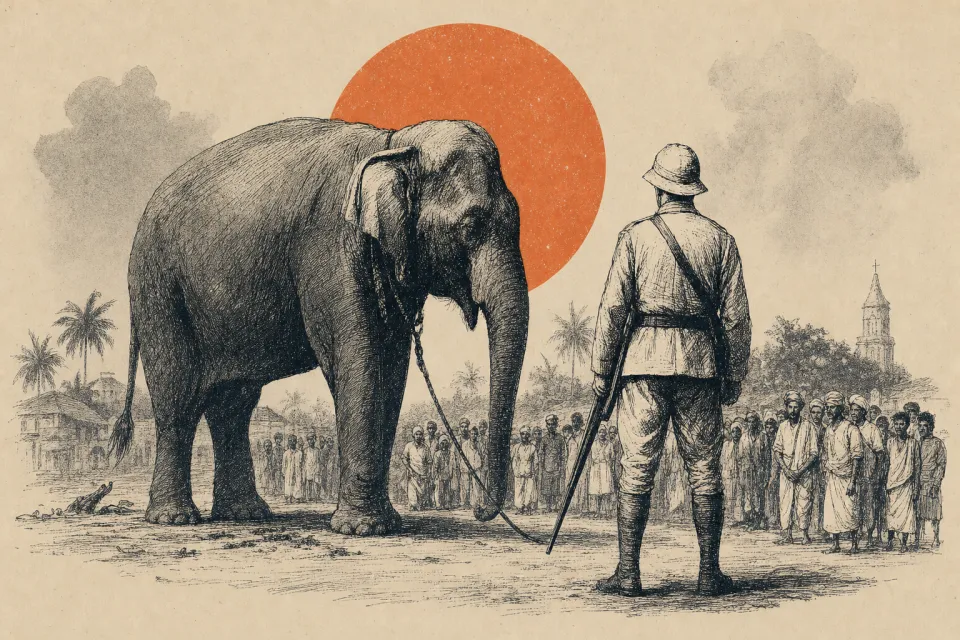
[文] 乔治·奥威尔:射象 Shooting an Elephant (by George Orwell)
最近在纸上写了不少东西,笔在纸面上滑动的阻力,重新把注意力带回了前科技时代,像回到小时候在笔记本上大量书写的时光。
一根笔、一张纸,能让思绪飞扬,也能让身心安宁。这种感受超乎想象,也让电子产品不再那么快地接管我的逻辑和情绪。
如果你好奇为什么在技术如此发达的今天,我还需要如此原始地徒手写画,可以阅读这篇小文。
 Kun Cheng

除了自己随手写写画画的文本草图和数理验算,我还抄了不少东西。
抄的中文是先秦诸子和唐宋诗词。它们都很简约,也从不屑制造废话。这些文本意味深长、思想深刻,不仅因为中国古人的智慧深邃,还因为那个时代的媒介物质短缺:纸笔极贵,文字是奢侈品,立言成本很高。而这种匮乏迫使那个时代的人非常尊重文字本身的价值。每个字都应该意有所指,含义隽永。
最近的英文抄写是乔治·奥威尔和E. B. 怀特。虽然奥威尔的文笔冷静辛辣,热衷讽刺,而怀特的文字随性自然,引人入胜,但他们都是出了名的用语精准、言辞简练的英美作家。
对这些尊重表达的作者,表达也会尊重他们。这些文字仍携带着他们的精神意识,继续存在于作者肉体消失后的世界。
可能没有什么方式比这种方式更接近不朽。
上周抄写的是奥威尔的《射象》(Shooting an Elephant)。我很久没有读过如此冷静客观,甚至有些冷酷的文字了。文字记叙的故事,可以用“残忍”来形容。相比今天这些巨大的、彩虹泡沫般五光十色的互联网媒体内容,奥威尔的故事残忍但真实。
一个自诩是终极善人的存在,也不可避免地要建立在历史的杀伐之上,而我们自以为的正义、荣誉和勇气,放在自然和历史面前,可能远没有那么黑白分明。
无论有何意图、无论做出何种抉择,人不能标榜自己的善良、正义和荣誉是绝对的。因为活着这件事本身,无论是否经由我们许可,都包含着一定程度的破坏和杀戮。
艰难、选择和虚荣…这些处境是活人无法摆脱的一部分。无法逃避,也不能逃避。这是重回血肉淋漓的现实世界的真实感受。
Enjoy-
射象
[英] 乔治·奥威尔 George Orwell, 1936 | 中央编译出版社,董乐山 [译]
在下缅甸的毛淡棉,我遭到很多人的憎恨——在我一生之中,我居然这么引起重视,也就仅此一遭而已。我当时担任该市的分区警官,那里的反欧洲人情绪非常强烈,尽管漫无目的,只是在小事情上发泄发泄。没有人有足够胆量制造一场暴乱,但是要是有一个欧籍妇女单身经过市场,就有人会对她的衣服吐槟榔汁。作为一个警官,我成了明显的目标,只要安然无事,他们总要捉弄我。在足球场上,会有个手脚灵巧的缅甸球员把我绊倒,而裁判(又是个缅甸人)会装着没瞧见,于是观众就幸灾乐祸地大笑。这样的事发生了不止一桩。到了最后,我走到哪里,哪里就有年轻人揶揄嘲笑的黄脸在迎接我,待我走远了,他们就在后面起哄叫骂,这真叫我的神经受不了。闹得最凶的是年轻的和尚,该市有好几千个,个个似乎都没有别的事可做,只是站在街头,嘲弄路过的欧洲人。
这使我十分着恼,也使我不解。因为那时我已认清帝国主义是桩邪恶的事,下定决心要尽早辞职滚蛋。从理论上来说——那当然是在心底里——我完全站在缅甸人一边,反对他们的压迫者英国人。至于我所干的工作,我是极不愿意干的,这种不愿意的心情非我言语所能表达。在这样的一个工作岗位上,你可以直接看到帝国主义的卑鄙肮脏。可怜巴巴的犯人给关在臭气熏天的笼子里,长期监禁的犯人菜色的脸,被竹杖鞭打后瘢痕斑斑的屁股——这一切都使我有犯罪的感觉,压迫得我无法忍受。但是我无法认清楚这一切。我当时很年轻,没有受过什么教育,我不得不独自默默地思索着这些问题,在东方的英国人都承受着这种沉默。我当时甚至不知道大英帝国已濒于死亡,更不知道它比将要代替它的一些新帝国要好得多。我只知道我被夹在中间,我一边憎恨我所为之服务的帝国,但我又生那些存心不良的小鬼头的气,他们总是想方设法使我无法工作。我一方面认为英国统治是无法打破的暴政,一种长期压在被制服的人民身上的东西;另一方面我又认为世界上最大的乐事莫过于把刺刀捅入一个和尚的肚子。这样的感情是帝国主义正常的副产品;随便哪个英属印度的官员都会这么回答你,要是你能在他下班的时候问他。
有一天发生了一件事,很能间接地说明问题。这本是一件小事,但它使我比以前更清楚地看到了帝国主义的真正本质——暴虐的政府行为处事的真正动机。有一天清早,镇上另一头的一个派出所的副督察打电话给我,说是有一头象在市场上横冲直撞,问我能不能去处理一下。我不知道该怎么办,但是我想看一看究竟,就骑马出发了。我带上了步枪,那是一支老式的点四四口径温切斯特步枪,要打死一头象,这枪太小了,不过我想枪声可能起恐吓作用。一路上有各种各样的缅甸人拦住我,告诉我那头象干了些什么。这当然不是一头野象,而是一头发情的驯象。它本来是用铁链锁起来的,发情的驯象都是如此,但在头一天晚上它挣脱锁链逃跑了。唯能在发情期制服它的驯象人出来追赶,但奔错了方向,已到了要走十二小时的路程之外,而这头象在清早又突然出现在镇上。缅甸人平时没有武器,对它毫无办法。它已经踩平了一所竹屋,踩死了一头母牛,撞翻了几个水果摊,饱餐了一顿;它还碰上了市里的垃圾车,司机跳车逃跑,车子被它掀翻,乱踩一气。
缅甸副督察和几名印度警察在发现那头象的地方等我。这是个贫民区,在一个陡峭的山边,破烂的竹屋子挤在一起,屋顶铺的是棕榈叶。我记得那是个就要下雨的早晨,天空乌云密布,空气沉闷。我们开始询问大家,那头象到哪里去了,像平常一样,得不到确切的情报。在东方,情况总是这样:在远处的时候,事情听起来总是很清楚,可是你越走近出事的地点,事情就越模糊。有的人说,那头象朝那边去了,有的人又说是另一个方向,有的甚至说根本不知道有什么象逃跑的事。我几乎觉得整个事情可能都是谎话,这时忽然听到不远的地方有人在嚷嚷。我听到一声惊恐的喊叫:“走开!孩子!马上给我走开!”这时我见到一个老妇人手中拿着一根树枝从一所竹屋的后面出来,使劲地赶着一群赤身裸体的孩童。后面跟着另外一些妇女,嘴上啧啧出声,表示惊恐;显然那里有什么东西不能让孩子们见到。我绕到竹屋的后边,看到一个男人的尸体躺在泥中。他是个印度人,一个黑皮肤的德拉维人苦力,身上几乎一丝不挂,死去没有几分钟。他们说那头象在屋子边上突然向他袭来,用鼻子把他捉住,一脚踩在他背上,把他压扁在地上。当时正好是雨季,地上泥土很软,他的脸在地上划出了一条槽,有一尺深,几尺长。他俯扑在地上,双手张开,脑袋扭向一边。他的脸上尽是泥,睁大双眼,龇牙咧嘴,一脸剧痛难熬的样子。(可别对我说,凡是死者的脸上表情都是安详的。我所见到的尸体中,大多数是惨不忍睹的。)大象的巨足在他背上撕开皮,像人剥兔皮一样干净利落。我一见到尸体,就马上派人到附近一个朋友的家里去借一支打象的步枪来。我已经把我的马送走,免得它嗅到象的气味,受惊之下把我从它背上颠下来。
派去的人几分钟以后便带着一支步枪和五颗子弹回来,这中间又有几个缅甸人来到,告诉我们,那头象就在下面的稻田里,只有几百码远。我一起步走,几乎全区人人都出动了,他们从屋里出来跟着我。他们看到了步枪,都兴奋地叫喊说我要去打死那头象了。在那头象撞倒踩塌他们的竹屋时,他们对它并不表现出有多大的兴趣,可是如今它要给开枪打死了,情况忽然之间就不同了。他们觉得有点好玩,英国群众也会如此。此外,他们还想弄到象肉。这使我隐隐约约地感到有些不安。我并没有打算打死那头象——我派人去把那支枪取来只不过是在必要时进行自卫而已——而且有一大群人跟在你后面总是令你有些神经紧张。我大步下山,肩上扛着那支步枪,后面紧紧跟随着一群越来越多的人,看上去一定像个傻瓜,心中也感到自己成了一个傻瓜。到了山脚下,离开了那些竹屋子,有一条铺了碎石子的路,再过去,就是一片到处都是泥浆的稻田,有一千码宽,还没有犁过田,因为下过雨,田里水汪汪的,零零星星地长着一些杂草。那头象站在路边八码远的地方,左侧朝着我们。它一点也没有注意到群众的靠近。它把成捆的野草拔下来,在双膝上拍打,打干净了以后就送进嘴里。
我在碎石路上就停了步。我一见到那头象就完全有把握知道不应该打死它。把一头能做工的象打死是桩严重的事,这等于是捣毁一台昂贵的巨型机器,事情很明显,只要能够避免就要尽量避免。在那么一段距离之外,那头象安详地在嚼草,看上去像一头母牛一样没有危险。我当时想——我现在也这么想——它的发情大概已经过去了,因此它顶多就是漫无目的地在这一带闲逛,等驯象人回来逮住它。何况,我当初根本不想开枪打它。因此我决定从旁观察,看它不再撒野了,我就回去。
但是这时我回头看了一眼跟我来的人群。人越聚越多,至少已经有两千人了,把马路两头都远远地堵死了。我看着花花绿绿衣服上的一张张黄色的脸,这些脸上都为了这一点看热闹的乐趣而现出高兴和兴奋的神情,大家都认定这头象是必死无疑了。他们看着我,就像看着魔术师变戏法一样。他们并不喜欢我,但是由于我手中有那支神奇的枪,我就值得一观了。我突然明白了,我非得射杀那头大象不可。大家都这么期待着我,我非这么做不可;我可以感觉得到他们两千个人的意志在不可抗拒地把我推向前。就在这个当儿,就在我手中握着那支步枪站在那儿的时候,我第一次看到了白人在东方的统治的空虚和无用。我这个手中握枪的白人,站在没有任何武装的本地群众前面,表面看来似乎是一出戏的主角;但在实际上,我不过是身后这些黄脸的意志所推来推去的一个可笑的傀儡。我这时看到,一旦白人开始变成一个暴君,他就毁了自己的自由。他成了一个空虚的、装模作样的木头人,常见的白人老爷的角色。因为正是他的统治使得他一辈子要尽力镇住“土著”,因此在每一次紧急时刻,他非得做“土著”期望他做的事不可。他戴着面具,日子长了以后,他的脸按照面具长了起来,与面具吻合无间了,我非得射杀那头象不可,我在派人去取枪时就不可挽回地表示要这样做了。白人老爷的行为必须像个白人老爷;他必须表现出态度坚决,做事果断。手里握着枪,背后又有两千人跟着,到了这里又临阵胆怯,就此罢手,这可不行。大家都会笑话我,我整个一生,在东方的每一个白人的一生,都是长期奋斗的一生,是绝不能给人笑话的。
但是我又不愿意射杀那头大象。我瞧着它卷起一束草在膝头甩着,神情专注,像一个安详的老祖母。我觉得朝它开枪无异于谋杀。按我当时的年龄,杀死个把兽类我是没有什么顾忌或不安的,但是我从来没有开枪打过大象,我也不想这么做。(杀死巨兽总是使人觉得更不应该一些。)何况,还有象主人得考虑。这头活象至少可值一百镑,死了,只有象牙值钱,可能卖五镑。不过我得马上行动。我转身向几个原来已在那里的看起来颇有经验的缅甸人,问他们那头象老实不老实。他们说的都一样:如果你让它去,它不理你;如果你走得太近,它就向你冲来。
我该怎么办,看来很清楚。我应该走近一些,大约二十五码左右,去试试它的脾性。要是它冲过来,我就开枪;要是它不理我,那就让它去,等驯象人回来再说。但是我也知道,这事我恐怕办不到,我的枪法不好,田里的泥又湿又软,走一步就陷一脚。要是大象冲过来而我又没有射中,我的命运就像推土机下的一只蛤蟆。不过即使在这时候,我想的也并不完全是自己的性命,而是身后那些看热闹的黄脸。因为在那时候,有这么多人瞧着我,我不能像只有我自己一个人那样害怕。在“土著”面前,白人不能害怕;因此,一般来说,他是不会害怕的。我心中唯一的想法是,要是出了差错,那两千个缅甸人就会看到我被大象追逐、逮住、踩成肉酱,就像山上那个龇牙咧嘴的印度人尸体一样。要是发生这样的事情,他们中间有些人很可能会笑话我。我不能让他们笑话我。只有一个办法。我把子弹上了膛,趴在地上好瞄准。
人群十分寂静,许许多多人从喉咙里叹出了一口低沉、高兴的气,好像看戏的观众看到帷幕终于拉开时一样,终于等到有好戏可瞧了。那支漂亮的德国步枪上有十字瞄准线。我当时根本不知道,要射杀一头象得瞄准双耳的耳孔之间的一条假想线,开枪把它切断。因此,如今这头象侧着身子对我,我就应该瞄准直射它的一只耳孔就行了;但在实际上,我却把枪头瞄准在耳孔前面的几英寸处,以为象脑在这前面。
我扣扳机时,没有听到枪声,也没有感到后坐力——开枪打中的时你总是不会感到的——但是我听到了群众顿时爆发出高兴的欢叫声。就在这个当儿——真是太快了,你会觉得子弹怎么会这么快就飞到了那里——那头象一下子变了样,神秘而又可怕地变了样。它没有动,也没有倒下,但是它身上的每一根线条都变了。它一下子变老了,全身萎缩,好像那颗子弹的可怕威力没有把它打得躺下,却使它僵死在那里了。经过很长时间,我估计大约有五秒钟,它终于四腿发软跪了下来。它的嘴巴淌口水。全身出现了老态龙钟的样子。你觉得它仿佛已有好几千岁了。我朝原来的地方又开了一枪。它中了第二枪后还不肯瘫倒,虽然很迟缓,它还是努力要站起来,勉强地站着,四腿发软,脑袋耷拉。我开了第三枪。这一枪终于结果了它。你可以看到这一枪的痛苦使它全身一震,把它四条腿剩下的一点点力气都打掉了。但它在倒下的时候还好像要站起来,因为它两条后腿瘫在它身下时,它仿佛像一块巨石倒下时一样,上身却抬了起来,长鼻冲天,像棵大树。它长吼一声,这是它第一声吼叫,也是仅有的一声吼叫。最后它肚子朝着我这一边倒了下来,地面一震,甚至在我趴着的地方也感觉得到。
我站了起来。那些缅甸人早已抢在前面跑到田里去了。显然那头象再也站不起来了,但它还没有死,它还在有节奏地喘着气,喉咙呼噜呼噜地出声,它的半边身子痛苦地一起一伏。它的嘴巴张得大大的,我可以一直看到粉红色喉咙的深处。我等它死去,等了很久,但它的呼吸并不减弱。最后我把剩下的两颗子弹射到我估计是它心脏的位置。浓血喷涌而出,好像红色的天鹅绒一般,可是它还不肯死。它中枪时身子并不震动,痛苦的喘息仍继续不断。它在慢慢地、极其痛苦地死去,但是它已到了一个远离我的世界,子弹已经不能再伤害它了。我觉得我应该结束那讨厌的喘息声。看着那头巨兽躺在那里,没法动弹,又没法死掉,又不能把它马上结果掉,很不是滋味。我又派人去把我的小口径步枪取来,朝它的心脏和喉咙里开了一枪又一枪。但似乎一点影响也没有。痛苦的喘息声继续不断,就像钟声滴答一样。
我终于再也无法忍受了,就离开了那里。后来听说它过了半个小时才死掉。缅甸人还没有等我走开就提着桶和篮子来了。据说到了下午他们已把它剥得只剩骨骼了。
后来,关于射杀那头象的事,当然议论不断。象主人很生气,但他是个印度人,一点也没有办法。何况,从法律的观点来说,我做得并不错,因为如果主人无法控制的话,发狂的象是必须打死的,就像疯狗一样。至于在欧洲人中间,意见就不一了。年纪大的人说我做得对,年纪轻的人说为了踩死一个苦力而开枪打死一头象太不像话了,因为象比科林吉苦力值钱。我事后心中暗喜,那个苦力死得好,使我可以名正言顺地射死那头象,在法律上处于正确地位。我常常在想,别人知不知道我射死那头象只是为了不想在大家面前显得像个傻瓜而已。
Shooting an Elephant
George Orwell, Published by New Writing, 2, Autumn 1936
In Moulmein, in lower Burma, I was hated by large numbers of people – the only time in my life that I have been important enough for this to happen to me. I was sub-divisional police officer of the town, and in an aimless, petty kind of way anti-European feeling was very bitter. No one had the guts to raise a riot, but if a European woman went through the bazaars alone somebody would probably spit betel juice over her dress. As a police officer I was an obvious target and was baited whenever it seemed safe to do so. When a nimble Burman tripped me up on the football field and the referee (another Burman) looked the other way, the crowd yelled with hideous laughter. This happened more than once. In the end the sneering yellow faces of young men that met me everywhere, the insults hooted after me when I was at a safe distance, got badly on my nerves. The young Buddhist priests were the worst of all. There were several thousands of them in the town and none of them seemed to have anything to do except stand on street corners and jeer at Europeans.
All this was perplexing and upsetting. For at that time I had already made up my mind that imperialism was an evil thing and the sooner I chucked up my job and got out of it the better. Theoretically – and secretly, of course – I was all for the Burmese and all against their oppressors, the British. As for the job I was doing, I hated it more bitterly than I can perhaps make clear. In a job like that you see the dirty work of Empire at close quarters. The wretched prisoners huddling in the stinking cages of the lock-ups, the grey, cowed faces of the long-term convicts, the scarred buttocks of the men who had been Bogged with bamboos – all these oppressed me with an intolerable sense of guilt. But I could get nothing into perspective. I was young and ill-educated and I had had to think out my problems in the utter silence that is imposed on every Englishman in the East. I did not even know that the British Empire is dying, still less did I know that it is a great deal better than the younger empires that are going to supplant it. All I knew was that I was stuck between my hatred of the empire I served and my rage against the evil-spirited little beasts who tried to make my job impossible. With one part of my mind I thought of the British Raj as an unbreakable tyranny, as something clamped down, in saecula saeculorum, upon the will of prostrate peoples; with another part I thought that the greatest joy in the world would be to drive a bayonet into a Buddhist priest’s guts. Feelings like these are the normal by-products of imperialism; ask any Anglo-Indian official, if you can catch him off duty.
One day something happened which in a roundabout way was enlightening. It was a tiny incident in itself, but it gave me a better glimpse than I had had before of the real nature of imperialism – the real motives for which despotic governments act. Early one morning the sub-inspector at a police station the other end of the town rang me up on the phone and said that an elephant was ravaging the bazaar. Would I please come and do something about it? I did not know what I could do, but I wanted to see what was happening and I got on to a pony and started out. I took my rifle, an old 44 Winchester and much too small to kill an elephant, but I thought the noise might be useful in terrorem. Various Burmans stopped me on the way and told me about the elephant’s doings. It was not, of course, a wild elephant, but a tame one which had gone “must.” It had been chained up, as tame elephants always are when their attack of “must” is due, but on the previous night it had broken its chain and escaped. Its mahout, the only person who could manage it when it was in that state, had set out in pursuit, but had taken the wrong direction and was now twelve hours’ journey away, and in the morning the elephant had suddenly reappeared in the town. The Burmese population had no weapons and were quite helpless against it. It had already destroyed somebody’s bamboo hut, killed a cow and raided some fruit-stalls and devoured the stock; also it had met the municipal rubbish van and, when the driver jumped out and took to his heels, had turned the van over and inflicted violences upon it.
The Burmese sub-inspector and some Indian constables were waiting for me in the quarter where the elephant had been seen. It was a very poor quarter, a labyrinth of squalid bamboo huts, thatched with palmleaf, winding all over a steep hillside. I remember that it was a cloudy, stuffy morning at the beginning of the rains. We began questioning the people as to where the elephant had gone and, as usual, failed to get any definite information. That is invariably the case in the East; a story always sounds clear enough at a distance, but the nearer you get to the scene of events the vaguer it becomes. Some of the people said that the elephant had gone in one direction, some said that he had gone in another, some professed not even to have heard of any elephant. I had almost made up my mind that the whole story was a pack of lies, when we heard yells a little distance away. There was a loud, scandalized cry of “Go away, child! Go away this instant!” and an old woman with a switch in her hand came round the corner of a hut, violently shooing away a crowd of naked children. Some more women followed, clicking their tongues and exclaiming; evidently there was something that the children ought not to have seen. I rounded the hut and saw a man’s dead body sprawling in the mud. He was an Indian, a black Dravidian coolie, almost naked, and he could not have been dead many minutes. The people said that the elephant had come suddenly upon him round the corner of the hut, caught him with its trunk, put its foot on his back and ground him into the earth. This was the rainy season and the ground was soft, and his face had scored a trench a foot deep and a couple of yards long. He was lying on his belly with arms crucified and head sharply twisted to one side. His face was coated with mud, the eyes wide open, the teeth bared and grinning with an expression of unendurable agony. (Never tell me, by the way, that the dead look peaceful. Most of the corpses I have seen looked devilish.) The friction of the great beast’s foot had stripped the skin from his back as neatly as one skins a rabbit. As soon as I saw the dead man I sent an orderly to a friend’s house nearby to borrow an elephant rifle. I had already sent back the pony, not wanting it to go mad with fright and throw me if it smelt the elephant.
The orderly came back in a few minutes with a rifle and five cartridges, and meanwhile some Burmans had arrived and told us that the elephant was in the paddy fields below, only a few hundred yards away. As I started forward practically the whole population of the quarter flocked out of the houses and followed me. They had seen the rifle and were all shouting excitedly that I was going to shoot the elephant. They had not shown much interest in the elephant when he was merely ravaging their homes, but it was different now that he was going to be shot. It was a bit of fun to them, as it would be to an English crowd; besides they wanted the meat. It made me vaguely uneasy. I had no intention of shooting the elephant – I had merely sent for the rifle to defend myself if necessary – and it is always unnerving to have a crowd following you. I marched down the hill, looking and feeling a fool, with the rifle over my shoulder and an ever-growing army of people jostling at my heels. At the bottom, when you got away from the huts, there was a metalled road and beyond that a miry waste of paddy fields a thousand yards across, not yet ploughed but soggy from the first rains and dotted with coarse grass. The elephant was standing eight yards from the road, his left side towards us. He took not the slightest notice of the crowd’s approach. He was tearing up bunches of grass, beating them against his knees to clean them and stuffing them into his mouth.
I had halted on the road. As soon as I saw the elephant I knew with perfect certainty that I ought not to shoot him. It is a serious matter to shoot a working elephant – it is comparable to destroying a huge and costly piece of machinery – and obviously one ought not to do it if it can possibly be avoided. And at that distance, peacefully eating, the elephant looked no more dangerous than a cow. I thought then and I think now that his attack of “must” was already passing off; in which case he would merely wander harmlessly about until the mahout came back and caught him. Moreover, I did not in the least want to shoot him. I decided that I would watch him for a little while to make sure that he did not turn savage again, and then go home.
But at that moment I glanced round at the crowd that had followed me. It was an immense crowd, two thousand at the least and growing every minute. It blocked the road for a long distance on either side. I looked at the sea of yellow faces above the garish clothes-faces all happy and excited over this bit of fun, all certain that the elephant was going to be shot. They were watching me as they would watch a conjurer about to perform a trick. They did not like me, but with the magical rifle in my hands I was momentarily worth watching. And suddenly I realized that I should have to shoot the elephant after all. The people expected it of me and I had got to do it; I could feel their two thousand wills pressing me forward, irresistibly. And it was at this moment, as I stood there with the rifle in my hands, that I first grasped the hollowness, the futility of the white man’s dominion in the East. Here was I, the white man with his gun, standing in front of the unarmed native crowd – seemingly the leading actor of the piece; but in reality I was only an absurd puppet pushed to and fro by the will of those yellow faces behind. I perceived in this moment that when the white man turns tyrant it is his own freedom that he destroys. He becomes a sort of hollow, posing dummy, the conventionalized figure of a sahib. For it is the condition of his rule that he shall spend his life in trying to impress the “natives,” and so in every crisis he has got to do what the “natives” expect of him. He wears a mask, and his face grows to fit it. I had got to shoot the elephant. I had committed myself to doing it when I sent for the rifle. A sahib has got to act like a sahib; he has got to appear resolute, to know his own mind and do definite things. To come all that way, rifle in hand, with two thousand people marching at my heels, and then to trail feebly away, having done nothing – no, that was impossible. The crowd would laugh at me. And my whole life, every white man’s life in the East, was one long struggle not to be laughed at.
But I did not want to shoot the elephant. I watched him beating his bunch of grass against his knees, with that preoccupied grandmotherly air that elephants have. It seemed to me that it would be murder to shoot him. At that age I was not squeamish about killing animals, but I had never shot an elephant and never wanted to. (Somehow it always seems worse to kill a large animal.) Besides, there was the beast’s owner to be considered. Alive, the elephant was worth at least a hundred pounds; dead, he would only be worth the value of his tusks, five pounds, possibly. But I had got to act quickly. I turned to some experienced-looking Burmans who had been there when we arrived, and asked them how the elephant had been behaving. They all said the same thing: he took no notice of you if you left him alone, but he might charge if you went too close to him.
It was perfectly clear to me what I ought to do. I ought to walk up to within, say, twenty-five yards of the elephant and test his behavior. If he charged, I could shoot; if he took no notice of me, it would be safe to leave him until the mahout came back. But also I knew that I was going to do no such thing. I was a poor shot with a rifle and the ground was soft mud into which one would sink at every step. If the elephant charged and I missed him, I should have about as much chance as a toad under a steam-roller. But even then I was not thinking particularly of my own skin, only of the watchful yellow faces behind. For at that moment, with the crowd watching me, I was not afraid in the ordinary sense, as I would have been if I had been alone. A white man mustn’t be frightened in front of “natives”; and so, in general, he isn’t frightened. The sole thought in my mind was that if anything went wrong those two thousand Burmans would see me pursued, caught, trampled on and reduced to a grinning corpse like that Indian up the hill. And if that happened it was quite probable that some of them would laugh. That would never do.
There was only one alternative. I shoved the cartridges into the magazine and lay down on the road to get a better aim. The crowd grew very still, and a deep, low, happy sigh, as of people who see the theatre curtain go up at last, breathed from innumerable throats. They were going to have their bit of fun after all. The rifle was a beautiful German thing with cross-hair sights. I did not then know that in shooting an elephant one would shoot to cut an imaginary bar running from ear-hole to ear-hole. I ought, therefore, as the elephant was sideways on, to have aimed straight at his ear-hole, actually I aimed several inches in front of this, thinking the brain would be further forward.
When I pulled the trigger I did not hear the bang or feel the kick – one never does when a shot goes home – but I heard the devilish roar of glee that went up from the crowd. In that instant, in too short a time, one would have thought, even for the bullet to get there, a mysterious, terrible change had come over the elephant. He neither stirred nor fell, but every line of his body had altered. He looked suddenly stricken, shrunken, immensely old, as though the frightful impact of the bullet had paralysed him without knocking him down. At last, after what seemed a long time – it might have been five seconds, I dare say – he sagged flabbily to his knees. His mouth slobbered. An enormous senility seemed to have settled upon him. One could have imagined him thousands of years old. I fired again into the same spot. At the second shot he did not collapse but climbed with desperate slowness to his feet and stood weakly upright, with legs sagging and head drooping. I fired a third time. That was the shot that did for him. You could see the agony of it jolt his whole body and knock the last remnant of strength from his legs. But in falling he seemed for a moment to rise, for as his hind legs collapsed beneath him he seemed to tower upward like a huge rock toppling, his trunk reaching skyward like a tree. He trumpeted, for the first and only time. And then down he came, his belly towards me, with a crash that seemed to shake the ground even where I lay.
I got up. The Burmans were already racing past me across the mud. It was obvious that the elephant would never rise again, but he was not dead. He was breathing very rhythmically with long rattling gasps, his great mound of a side painfully rising and falling. His mouth was wide open – I could see far down into caverns of pale pink throat. I waited a long time for him to die, but his breathing did not weaken. Finally I fired my two remaining shots into the spot where I thought his heart must be. The thick blood welled out of him like red velvet, but still he did not die. His body did not even jerk when the shots hit him, the tortured breathing continued without a pause. He was dying, very slowly and in great agony, but in some world remote from me where not even a bullet could damage him further. I felt that I had got to put an end to that dreadful noise. It seemed dreadful to see the great beast Lying there, powerless to move and yet powerless to die, and not even to be able to finish him. I sent back for my small rifle and poured shot after shot into his heart and down his throat. They seemed to make no impression. The tortured gasps continued as steadily as the ticking of a clock.
In the end I could not stand it any longer and went away. I heard later that it took him half an hour to die. Burmans were bringing dash and baskets even before I left, and I was told they had stripped his body almost to the bones by the afternoon.
Afterwards, of course, there were endless discussions about the shooting of the elephant. The owner was furious, but he was only an Indian and could do nothing. Besides, legally I had done the right thing, for a mad elephant has to be killed, like a mad dog, if its owner fails to control it. Among the Europeans opinion was divided. The older men said I was right, the younger men said it was a damn shame to shoot an elephant for killing a coolie, because an elephant was worth more than any damn Coringhee coolie. And afterwards I was very glad that the coolie had been killed; it put me legally in the right and it gave me a sufficient pretext for shooting the elephant. I often wondered whether any of the others grasped that I had done it solely to avoid looking a fool.
Reference 参考资料
- [英]乔治·奥威尔文集,中央编译出版社,董乐山 [译]
- www.orwellfoundation.com/the-orwell-foundation/orwell/essays-and-other-works/shooting-an-elephant
Member discussion